Chapter One: The Face
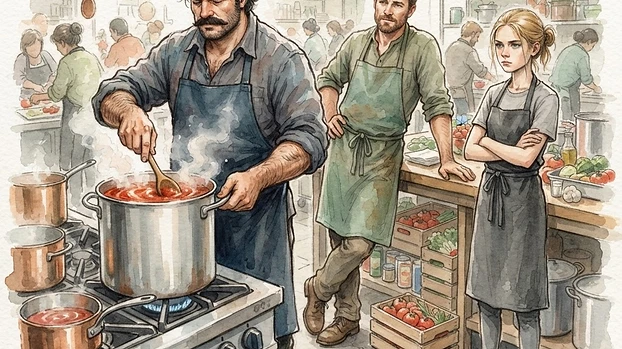
Years had passed since the storm.
Five years since Sum-ma had sat with Theresa at the kitchen table, explaining that womanhood did not arrive with permission, music, or a neatly written instruction card. It simply knocked over a glass of water, stained a favorite pair of shorts, and expected everyone involved to remain calm.
Theresa had not remained calm then.
At sixteen, however, Theresa had become almost unnervingly calm.
She had grown into a tall, lean young woman with the balanced strength of someone who had spent years running soccer fields, practicing gymnastics, and carrying fifty-pound sacks of onions because she refused to ask anyone else to do something she could accomplish herself. Her blond hair, so much like Gruff’s, was usually tied into a practical knot behind her head. She wore little makeup, rarely raised her voice, and possessed the unsettling ability to stare at a person until they reconsidered every decision they had made since breakfast.
Gruff was extremely proud of this.
Brute found it terrifying.
“She’s doing it again,” Brute whispered one Saturday afternoon from beside the prep counter, where crates of donated tomatoes sat sweating under the fluorescent lights.
Gruff did not look up from the deep stockpot of tomato sauce he was stirring on the industrial stove. Steam clouded his glasses for a second before he answered.
“Doing what?” Gruff asked.
“The face,” Brute said, keeping his voice low as volunteers moved trays and ladles behind them.
“She has several,” Gruff said, scraping the wooden spoon along the bottom of the pot.
“The one that makes me feel like I’m being audited,” Brute said, peering across the kitchen line.
Across the soup kitchen’s commercial line, beneath the metallic clatter of pans and the warm smell of garlic, Theresa stood with her arms folded. Her chef’s jacket was buttoned neatly, her apron was spotless, and one eyebrow had lifted by perhaps half an inch.
In front of Theresa, Freddy stood under the heat lamps holding a tray of garlic bread that had been transformed into something resembling charcoal roofing shingles.
Freddy was fifteen now, though his body appeared to have skipped fifteen and gone directly to twenty-two. He had Brute’s broad shoulders, thick arms, and sturdy build. His football coach had begun referring to him as “the wall,” which Freddy accepted as both a compliment and a possible future business name.
The first traces of facial hair had appeared above his lip. They were visible primarily when sunlight struck him at a specific angle, but Freddy treated them as though he had grown the beard of an ancient mountain king.
He rubbed his chin thoughtfully.
“I was experimenting,” Freddy said, lifting the tray as if its blackened contents were scientific evidence rather than dinner.
Theresa’s eyebrow moved another fraction upward.
“With what?” Theresa asked, her voice so calm that Brute visibly worried for Freddy’s future.
“Heat,” Freddy said.
“Fire has already been invented,” Theresa said.
“I was studying its applications,” Freddy replied.
“You put garlic bread under a broiler and walked away,” Theresa said, pointing the tip of her bread knife toward the guilty appliance.
“I was called to an emergency,” Freddy said, glancing toward the dining room.
Theresa followed his gaze toward the dining room, where folding tables had been set with paper napkins and mismatched saltshakers, and where Brute had been teaching Freddy how to bounce a dinner roll off the wall and catch it in his mouth.
“You were attempting food-based geometry,” Theresa said.
“Trajectory matters in engineering,” Freddy said.
“You threw bread at Baba,” Theresa said.
“He moved,” Freddy said.
“I was retrieving a napkin,” Brute protested from beside a rolling rack of clean trays. “I became an unwilling participant in science.”
Gruff tasted the sauce, judged it with a brief silence, and reached for the oregano.
“You encouraged him,” Gruff said to Brute.
“I encourage curiosity,” Brute said.
“You shouted, ‘Bank it off the wall,’” Gruff said.
“I was offering guidance,” Brute said, as if this settled the matter.
Theresa turned her attention back to Freddy, still standing under the heat lamps with the ruined tray angled awkwardly in both hands. The lamps cast a greasy orange shine over the blackened bread, and a bitter, smoky smell curled up from it, cutting through the warmer scent of tomato sauce, garlic, and wet lettuce. Around them, the soup kitchen kept moving: water hissed in the prep sink, pans rang against metal shelves, and the ventilation hood hummed above the stove like a tired machine refusing to quit.
Theresa shifted her weight onto one hip and looked from Freddy to the tray, then back to Freddy. Her face remained almost perfectly smooth, but one corner of her mouth tightened in the way that made Brute quietly step farther from the evidence. “How many pieces did you burn?” she asked, each word clipped and precise, as if she were entering evidence into the record.
Freddy looked down at the tray, where the garlic bread sat in a neat, tragic row. The crusts had blistered into hard black ridges, and when he shifted the pan, flakes of ash skittered across the metal with a dry, papery sound.
Freddy tucked his elbows closer to his sides and gave the tray a small, guilty lift. His eyes moved hopefully to Brute, whose eyebrows rose in a silent, deeply unhelpful suggestion that Freddy save himself. “Define burn,” Freddy said, attempting confidence and landing somewhere closer to negotiation.
Theresa did not blink. She only tilted her head, just enough to make Freddy’s shoulders sink another inch. Behind her, Gruff’s expression stayed hidden in the steam rising from the sauce, but Brute’s face had arranged itself into the helpless sympathy of a man watching another man walk into a door. “The state between edible and evidence,” Theresa said.
Freddy glanced toward Brute for help, found only a wince and a tiny shrug, and looked back down at the tray. The kitchen lights caught the ash on the bread and made it look dusted with gray snow. “Twenty-four,” he said after a cautious count, his voice lifting hopefully on the number.
“Twenty-eight,” Gruff corrected from the stove without turning around, the number landing flat and final over the simmering sauce. He tapped the spoon once against the rim of the pot, and the small sound somehow made Freddy flinch.
Freddy counted again, this time moving one finger carefully over each blackened piece. The tray was still warm enough that he kept his touch light, tapping quickly as if the bread might accuse him if he lingered.
Freddy’s chin dipped. His mouth pulled sideways, not quite a grimace and not quite a smile, the expression of someone discovering that math had betrayed him. “Twenty-eight,” he admitted, much smaller this time.
Theresa took the tray from him and held it away from her apron as if the smoke might stain on contact. The metal pan clicked against her fingernails, and a thin ribbon of heat rose between them before vanishing into the kitchen’s humming ventilation.
Theresa held the tray between two fingers, away from her body, and gave Freddy a look over the rim of it. The heat from the pan flushed faint color across her cheeks, though her expression remained judicial. “You are paying for these,” she said, not loudly, which somehow made it worse.
Freddy spread one hand against his chest, eyes widening with theatrical innocence. Brute, recognizing the performance because he had invented several versions of it, pressed his lips together to keep from coaching. “I’m a minor,” Freddy said quickly, as if legal status might provide emergency shelter.
“You have a job,” Theresa said, turning toward the trash bin beside the prep sink, where cold water ran over lettuce leaves with a steady hiss. A volunteer glanced over at the word job, saw Theresa’s face, and wisely returned to rinsing.
Freddy straightened a little and adjusted his stance, grateful to have found a credential. His eyebrows lifted with renewed dignity. “I assist Baba with social media,” he said.
Theresa paused beside the trash bin and turned back slowly. Her eyes narrowed by the smallest possible degree. “You filmed him dancing beside a stockpot and added the words ‘Soup Daddy Saturday,’” she said, her expression suggesting this was not the defense Freddy imagined.
Freddy’s face brightened so suddenly that even the ruined bread seemed less ashamed. He leaned forward, eager to present the one fact he believed would redeem the entire disaster. “The video received twelve thousand views,” he replied.
Brute pointed at Freddy proudly from beside the rolling rack, as if the boy had just presented quarterly earnings.
Brute puffed out his chest and pointed both thumbs toward himself, his grin spreading before he could restrain it. “And three marriage proposals,” he added, unable to keep the pride out of his voice.
“You are already married,” Gruff said, still stirring the sauce with the patience of a man who had survived worse conversations.
Brute’s thumbs dropped. He scratched the back of his neck, and his grin collapsed into something smaller and guiltier. “I politely declined,” he said, a little too quickly.
“You sent one of them a heart,” Gruff said.
Brute lowered his chin and folded his arms loosely, slipping into the tone of a man presenting a business strategy he knew would not survive questions. “It was customer engagement,” he said.
Gruff finally looked over his shoulder, the wooden spoon paused above the pot. Steam slipped past his face, but not enough to soften the look he gave Brute.
Brute cleared his throat and straightened beneath the weight of Gruff’s silence. Freddy watched him with open admiration, as if witnessing a man survive a natural disaster.
Brute’s posture snapped suddenly formal, hands clasped in front of him like he had been called before a board. “I will review our social media response policy,” he said.
Theresa carried the ruined bread toward the trash, weaving past stacked mixing bowls, a volunteer rinsing lettuce at the sink, and a cart of clean plates that rattled softly whenever someone brushed against it. The kitchen floor was damp in places from melted ice and vegetable wash, and her shoes made quiet rubber squeaks as she crossed it. Behind her, Freddy tracked the tray with mournful eyes, while Brute watched Theresa’s back with the wary respect of a man who had survived many kitchens but never fully understood their laws.
“Review the marriage section first,” Theresa said over her shoulder, and the faintest curve touched her mouth before she dropped the blackened bread into the bin with a brittle clatter.
Freddy leaned closer to Brute, lowering his voice but not his outrage. His eyes stayed on Theresa as she crossed to the trash bin, half wounded and half impressed, the way he looked whenever his sister defeated him too cleanly.
“She has become increasingly hostile toward innovation,” Freddy muttered, trying for injured dignity and missing only because his mouth kept threatening to smile.
Brute leaned down as if sharing classified information. “She gets that from Gruff,” he whispered, though affection warmed the accusation.
Gruff returned his attention to the sauce, but his shoulders shifted almost imperceptibly, as if he had heard every word and chosen not to enjoy it too visibly.
“No,” Gruff said, calm as the sauce simmering in front of him. “I allow innovation.”
Brute smiled with immediate relief, pleased to have found shelter behind Gruff’s authority.
“See?” Brute said to Freddy, spreading one hand as if the matter had been settled by the highest court available.
“I simply require it to be useful,” Gruff added.
Brute’s smile disappeared so quickly it looked confiscated.
“See?” Freddy said softly, recovering enough to aim the word back at Brute.
Theresa opened the trash bin with one foot on the pedal, her expression smoothing into the dangerous calm that meant she had decided to enjoy herself.
“Gruff, should I put Freddy in with the bread?” she asked, glancing over her shoulder with only the faintest gleam in her eyes.
“Not unless you break him down for compost,” Gruff said, so evenly that it took Brute half a second to realize a joke had occurred.
Freddy placed a hand over his heart, wounded now in the grand theatrical manner Brute had clearly passed down to him.
“That was almost a joke,” Freddy said, both horrified and proud.
“It was an instruction,” Gruff said.
Freddy glanced from Gruff to Theresa and lowered his voice. “For the record, if I become compost, I request to nourish something dramatic. Maybe basil. Maybe a tree that leans judgmentally.”
Theresa lifted the ruined tray higher. “Your final wishes have been noted and denied.”
Brute touched Freddy’s shoulder with solemn ceremony. “Son, if this is the end, know that I admired your confidence and questioned your oven awareness.”
“That is a complicated legacy,” Freddy said.
“Most family legacies are,” Gruff said, stirring the sauce once, slow and deliberate. “Especially when they smell like charcoal.”
Theresa’s mouth twitched, and for a moment the stern line cook vanished beneath the older brother-and-sister delight of having successfully provoked the room.
Her humor had changed as she had grown older, becoming quieter and sharper, tucked behind stillness instead of thrown openly into the air. As a child, she had been quick, bright, and openly mischievous. She had once hidden a rubber snake in Brute’s bed and nearly caused him to leap through a window. She had talked to everyone, questioned everything, and moved through the world as though every room had been waiting specifically for her arrival.
There had been a time when Theresa’s jokes arrived first and her caution came later. Now caution stood at the door of every room before she entered, checking exits, listening for tone, deciding how much of herself the room deserved. The soup kitchen was one of the few places where she did not have to measure every word before releasing it.
Now she saved her words, not because she had less to say, but because she had learned that people listened differently when they had to lean in.
She observed before speaking. She carried herself like Gruff, with a quietness that people often mistook for shyness until they discovered the machinery operating beneath it. She did not collect friends, chase popularity, or concern herself with being invited anywhere. She was kind to everyone at school, including students who barely knew her name, but she kept a private distance around herself, the kind that looked like confidence from the outside and sometimes felt like loneliness from within.
That distance had not grown from coldness. It had grown from observation. Theresa had learned early that people revealed themselves most clearly when they assumed she was only listening. So she listened. She collected tones, contradictions, careless phrases, little injustices disguised as jokes. Later, when she finally spoke, people often mistook the precision for cruelty. They did not see how long she had waited before choosing the sentence.
When asked about it, she simply said, “I have people I respect,” as if respect were safer than needing anyone too much.
Gruff understood the answer better than she knew.
He had spent much of his own life surrounded by people while belonging to very few of them, and seeing that same careful distance in Theresa filled him with both pride and a quiet ache.
Theresa earned straight As, maintained a 4.0 grade-point average, played soccer, ran track during the off-season, and worked the Saturday dinner shift at the soup kitchen as a line cook. She wanted to become a lawyer, though she had not yet decided what kind.
“Something involving constitutional law,” she had told Gruff.
“What part?” Brute had asked.
“The part where people stop pretending rights only matter when they agree with the person using them.”
Brute had stared at her.
“I understood every word separately.”
Freddy had slapped him on the shoulder.
“Don’t worry, Baba. I’ll build the computers. She’ll sue them.”
Theresa placed the burned bread aside and began slicing a new loaf.
Freddy remained near the line, rubbing his nearly invisible mustache.
“Do you think this makes me look older?”
“No,” Theresa said.
“You didn’t look.”
“I have looked previously.”
“It is thicker today.”
“It is six hairs.”
“Seven.”
“One may be seasoning.”
Freddy inspected his finger.
“Pepper.”
Brute leaned against the counter.
“You know, when I was your age, I had a magnificent mustache.”
Gruff looked at him.
“No, you did not.”
Brute ignored him.
“It was full. Powerful. Commanding.”
“You have shown us photographs,” Theresa said. “You had three hairs on one side and optimism on the other.”
Freddy laughed so hard that he bumped into a stack of sheet pans.
Brute pointed at Theresa.
“That was Gruff’s kind of insult.”
Theresa continued slicing.
“I have been studying.”
“You’re supposed to study law.”
“I am preparing for cross-examination.”
“Of your own father?”
Theresa paused.
“You are not my father during kitchen hours. You are a sanitation risk.”
Freddy gripped the counter and wheezed.
Gruff’s mouth moved slightly at one corner.
That was how laughter usually appeared on him now: a small crack in a stone wall, brief but unmistakable.
Brute saw it.
“You’re encouraging her.”
“I am stirring sauce.”
“With approval.”
“Approval is difficult to stir.”
For a few minutes, the kitchen kept its easy rhythm. Volunteers moved behind them with the practiced choreography of people who knew where every ladle lived. Sauce bubbled, trays slid into ovens, and laughter bounced off the stainless steel without asking permission.
Theresa noticed all of it because noticing had become one of her habits: the way Gruff tasted sauce before judging anyone else, the way Brute filled silence before it could become uncomfortable, the way Freddy turned embarrassment into performance as if laughter were armor he could lend to everyone nearby.
She was reaching for another loaf when the phone began to vibrate. The sound was small, almost ordinary, but it changed the room before anyone knew why.
Theresa knew before Gruff looked at the screen that the call belonged to trouble. Ordinary calls did not make his hands go still. Ordinary calls did not cause Brute’s laughter to pause mid-breath or Freddy’s shoulders to square as if the ruined garlic bread had suddenly become irrelevant. Trouble had a way of entering quietly and rearranging everyone’s posture.
Before Brute could answer, Gruff’s phone vibrated against the stainless-steel table, the sound small but sharp enough to cut through the laughter.
He wiped his hand on a towel and looked at the screen. The humor left his face by degrees, not dramatically, but completely.
The name of Theresa and Freddy’s high school appeared above the number.
Brute wiped both hands on his apron and leaned closer, but Gruff turned slightly away, not to exclude him, only to keep the call calm. That small movement told Theresa more than the words did. Whatever the school wanted, Gruff had already decided the room would not hear panic from him first.
Gruff answered, and Theresa noticed Brute stop mid-breath.
Brute mouthed, Who is it? across the prep table, one hand still hovering over the cutting board. Freddy stopped rubbing his chin. Theresa kept the knife still against the bread, but her grip changed, tightening until the handle pressed a pale line into her palm.
“Hello?” Gruff said, his voice unchanged in the way that made everyone around him pay closer attention.
“Yes, she is here,” Gruff said after a pause. His eyes flicked to Theresa, then away so quickly it felt almost merciful.
His expression did not change while he listened, but Theresa noticed the way his shoulders settled. Gruff did not tense when something happened. He became still, and that stillness pulled the mood of the kitchen down around them.
“Yes,” he said. “I understand.”
Brute stopped smiling. The concern came over his face quickly, chasing away the last of the joke before he could hide it.
Freddy straightened, his earlier theatrical woundedness gone. He looked suddenly younger and larger at the same time, a boy with a man’s shoulders waiting to see if he needed to protect someone.
The change in him made the room feel smaller. A moment before, he had been a boy defending ruined bread with legal theories. Now his attention moved to Theresa the way a porch light turns on in the dark, automatic and immediate.
Gruff glanced at Theresa, and that one look reached her before the words did.
“When?”
Another pause.
Brute’s whisper came rougher this time. “Gruff.”
“We can be there Monday morning.”
Gruff lifted one finger without looking at him. Wait. The gesture was small, almost invisible, but everyone obeyed it.
He ended the call.
For a moment, the only sound in the kitchen was the low simmer of tomato sauce, thick and steady, as if the whole room were holding its breath around it.
Brute looked from Gruff to Theresa, his brow knitting as he tried to read the silence before anyone explained it. The joke had gone out of his face, leaving behind the startled fear he usually buried under volume.
“Which one of them did something?” Brute asked, but the question came out softer than usual, more worried than accusing.
“If it is Freddy, I have a prepared apology,” Brute added quickly. “It is flexible. Works for property damage, hallway incidents, and one unfortunate sprinkler misunderstanding.”
Freddy frowned. “That sprinkler was structurally curious before I arrived.”
“It became wetter after you arrived,” Theresa said.
Freddy pointed at himself automatically, then glanced at Theresa and let his hand hover there, uncertain. His face, still flushed from laughing, tightened with sudden concern.
“Why did you look at me first?” Freddy asked, trying for offense, though his eyes kept sliding back to Theresa.
“Statistics,” Brute said, but he did not smile after saying it.
Gruff slipped his phone back into his pocket with careful precision, as if any sudden movement might make the moment heavier.
“They want to meet with us about Theresa,” Gruff said. His voice remained level, but his eyes stayed on her face, watching for the reaction she would try not to show.
No one answered right away. The silence made room for every possibility, and every possibility seemed to find Theresa first.
The sentence seemed too small for the space it opened. Theresa felt every volunteer still moving around them, every spoon against every pan, yet the room narrowed to the distance between Gruff’s eyes and her own. About Theresa. Not Freddy. Not a misplaced diagram, not a hallway joke, not one of the ordinary disasters that followed her brother like loose change in a dryer. Her.
Freddy shifted closer, not touching her this time, only reducing the space between them. “What kind of about?” he asked.
Freddy slowly lowered his hand. The protective lift of his shoulders eased into confusion, then sharpened again as he looked at his sister.
Brute blinked, once, then again, as though the words had arrived in the wrong order.
“Theresa?” Brute asked, his forehead creasing deeper. The name sounded almost too careful in his mouth.
“Yes,” Gruff said.
“Our Theresa?” Brute pressed, and this time the question carried disbelief, pride, and the first spark of irritation on her behalf.
“We have one,” Gruff said, though his mouth softened slightly at Brute’s outrage.
“The quiet one?” Brute said, turning toward Theresa as if quietness should have protected her from administrative concern.
Theresa placed the knife flat against the cutting board. The small click of steel on wood sounded deliberate, and her face became so composed that Gruff knew she was bracing herself.
“What did they say?” Theresa asked. Her voice was steady, but her eyes had narrowed in concentration, already searching through every assignment, every question, every raised hand.
Brute’s eyes moved from the knife to her face. “Baby girl, if this is because you corrected another adult, blink twice.”
“Your English teacher has concerns about several assignments and discussions you have initiated in class,” Gruff said, choosing each word carefully so the sentence would not sound like an accusation.
“Concerns about what?” Theresa asked, and for the first time a faint line appeared between her brows.
“Define concerns,” Freddy said. “Because adults use that word for everything from ‘excellent essay’ to ‘why is there a traffic cone in the gym?’”
“She did not explain over the phone,” Gruff said. His eyes stayed calm, but the set of his jaw told Theresa he disliked being summoned without being told why.
Theresa thought for a moment. Her fingers moved once against the edge of the cutting board, not quite a tap, not quite a tremor.
Theresa hated that tiny movement of her hand. It betrayed more than she wanted to give away. She could argue in front of a classroom without shaking, but uncertainty had always found smaller places to live: a finger against a board, a breath held too long, the careful way she refused to ask if she was in trouble.
“It could be the essay on the death penalty,” she said, with the cautious honesty of someone opening a drawer and discovering it might contain more trouble than expected.
Brute’s eyes widened until his whole face seemed to pause around them.
“You wrote about executions?” he asked, the word executions landing with a mixture of alarm and reluctant admiration.
“Yes,” Theresa said, lifting her chin a fraction, as if preparing to defend not only the essay but her right to have written it.
“At school?” Brute asked, his voice rising despite his attempt to control it.
“That is where the assignment was given,” Theresa replied, a little dryly, though the corner of her mouth did not move.
“What was the assignment?” Brute asked, leaning forward now, visibly trying to build a legal defense out of panic.
“A persuasive essay,” Theresa said.
“What were the other children persuading people about?” Brute asked, already looking as though he feared the answer.
Freddy answered before Theresa could, his protective instincts briefly overridden by the opportunity to provide damning context.
“Longer lunch periods, school uniforms, social media, and whether homework should exist,” Freddy said, counting them off with growing disbelief.
Brute stared at Theresa, his mouth opening and closing once before he found the sentence he wanted.
“And you selected government-sanctioned death?” he asked, sounding both horrified and, against his will, impressed by the ambition.
“I selected whether a justice system can ethically administer irreversible punishment while admitting that the system itself makes mistakes,” Theresa said. Her voice steadied as she spoke, finding solid ground in the argument itself.
Brute looked at Gruff, silently pleading for a simpler universe.
“She could have done homework,” Brute said, weakly.
Gruff’s face remained calm, but Theresa saw the faint focus sharpen in his eyes. He was no longer reacting to the school’s call. He was beginning to understand it.
“What else?” Gruff asked, gently enough that Theresa knew he was not interrogating her. He was making room.
Theresa considered the question. Her eyes dropped to the cutting board, but not because she was ashamed. She looked as though she were sorting evidence into order, deciding which truth would hurt the least to say first.
“I challenged the way the textbook described homelessness,” she said. Her voice stayed controlled, but a faint flush climbed her throat, the kind that came from anger she refused to spend carelessly.
Gruff’s gaze sharpened. The softness he had used with her remained, but something colder settled behind it, not aimed at Theresa but at whatever sentence had made her stand alone in a classroom.
“How did it describe it?” Gruff asked, quietly enough that Brute stopped shifting beside him.
“As a consequence of poor decision-making and insufficient employment,” Theresa said. Her mouth tightened at the phrase, as if repeating it left a bad taste.
Brute’s humor vanished. His face went still first, then hard, the way it did whenever someone’s pain had been made to sound like a character flaw.
Theresa continued, more carefully now, because she could feel Brute’s anger rising beside her and Gruff’s attention narrowing into something protective.
“I explained that the section ignored disability, housing costs, domestic violence, medical debt, discrimination, mental illness, foster-care transitions, job loss, and the number of employed people who still cannot afford housing.” She looked up then, her eyes bright with restrained fury. “It made poverty sound like a failed personality test.”
Gruff nodded once. His expression did not soften, but his eyes did, and Theresa understood the difference.
“What else?” he asked. This time the words carried no suspicion at all, only a steady invitation to stop carrying the list alone.
“My teacher stopped a discussion after I asked whether school discipline policies are applied equally to all students,” Theresa said. Her face remained composed, but a small line appeared beside her mouth, the sign that she had already replayed the moment more than once.
Freddy raised his hand slightly, not as a joke this time but like someone volunteering from experience. His eyebrows drew together, and the corner of his mouth pulled down with old irritation.
“They are not,” Freddy said, quieter than his usual declarations.
Theresa looked at him, and some of the sharpness left her face. For all their arguing, she knew exactly when Freddy was joking and when he was handing her something real.
“I know,” Theresa said, and the words were gentler than before.
Freddy lifted his chin, recovering a little of himself. “I have supporting data.”
“You have detention slips,” Theresa replied, but her eyes warmed as she said it.
“Data comes in many forms,” Freddy said, spreading one hand with wounded scholarly dignity.
Brute pinched the bridge of his nose, but his eyes stayed open, fixed on Freddy with the weary concern of a man who had just discovered a side investigation.
“Freddy,” Brute said slowly, “what did you do?”
Freddy’s expression became carefully innocent, which immediately made it worse. “I corrected the principal’s parking.”
Brute’s hand fell from his face. “You moved his car?”
“I left a diagram,” Freddy said, as if this proved restraint.
“You drew him a diagram?”
“It showed the optimal angle.”
Gruff returned his attention to Theresa, though one eyebrow lowered in Freddy’s direction long enough to promise that the diagram would not be forgotten.
“Was there anything else?” Gruff asked Theresa, softer again.
She hesitated. This time the pause was different. Her eyes moved toward the dining room, away from all three of them, and her face lost its practiced certainty for the space of one breath.
Until that moment, Theresa had been able to sort the possible offenses into neat categories: provocative essay, classroom question, discussion that wandered farther than Ms. Harrow liked. The short story did not fit neatly. It was the assignment she had written with the most control and the least distance. She had told herself it was allegory. She had also known exactly whose empty shelf she was writing toward.
“I wrote a short story,” Theresa said, and the quietness in her voice made Brute stop preparing whatever joke had been forming.
Freddy studied her face. “That is the one,” he said, and his voice lost its jokes for a moment. “The library story.”
Theresa’s eyes flicked toward him. “You read it?”
“You left it on the printer. I was rescuing my fantasy football roster from beneath it.”
“That is not an explanation.”
“It is the origin story of accidental literacy,” Freddy said. Then he swallowed and added, “It was good, Theresa.”
Brute leaned forward, concern softening the wide planes of his face. “What kind of short story?”
“What kind of short story?” he asked again, more gently, when she did not answer immediately.
“It involved a girl whose school removed books about families like hers,” Theresa said. Her face stayed composed, but her eyes had gone guarded, as if she had opened a door and immediately expected someone to push it shut. One corner of her mouth pressed inward, not quite a frown, more like she was holding back the part of the story that mattered most.
For the first time since the phone call, Theresa looked less like she was listing assignments and more like she was uncovering the one that mattered. The kitchen noises kept going around her, but they seemed far away now, as if the story had placed a glass wall between her and the ordinary world.
Gruff said nothing. He only watched Theresa’s face, careful not to rush her, while Brute’s brows pulled together in a slow, troubled crease.
Theresa’s voice remained composed, but her fingers pressed against the handle of the bread knife until the skin over her knuckles paled. Her eyes flicked once toward Freddy, then away, as if checking whether he understood before she risked saying more.
“In the story, the girl began removing every book that did not resemble her own life,” Theresa said. “At first, people called it fairness. Then they called it balance. Eventually the library was empty.” Her lashes lowered on the last word, and for a second the sharpness left her face, revealing how personally she had felt the emptiness she had written.
Freddy whistled softly, then caught himself and softened his expression. “That is good,” he said, quieter than usual. “I mean, terrible. But good terrible. The kind that makes people realize they helped make the room empty.”
Brute looked impressed despite himself, but the admiration was tangled with worry. His mouth parted like he wanted to praise her and protect her from the consequences of being that clear at the same time.
“What happened at the end?” Brute asked, his voice lower now, as if the answer might bruise if handled too roughly.
“The girl asked why nobody had stopped her,” Theresa said. A small muscle moved in her cheek. “The librarian said everyone had been too busy deciding which children deserved to recognize themselves.”
Gruff’s eyes stayed on Theresa. The room was quiet enough that the soft scrape of Freddy shifting his feet sounded loud.
“And your teacher objected?” Gruff asked, though his expression suggested he already knew the answer and disliked it.
“She said it was inflammatory,” Theresa said. The word came out flat, but her nostrils flared once before she smoothed her expression again.
“Was it?” Gruff asked.
Theresa thought about it. Her gaze moved to the trash bin, then back to Gruff, and the faintest trace of defiance returned to her eyes. It did not arrive all at once. First her lashes lifted. Then the tightness at the corner of her mouth eased into something steadier, something almost relieved, as though saying the truth plainly had given her back a little room to breathe.
“Yes,” she said.
Brute waited, his face caught between dread and pride. His eyes shone with the alarm of a father imagining consequences and the admiration of a man who knew exactly why she had invited them.
Theresa lifted one shoulder in the smallest possible shrug, though her eyes did not leave Gruff’s. Her chin trembled once, almost invisibly, before she set it again. “Deliberately.”
Freddy grinned, but it was not teasing. It was fierce and loyal, the kind of grin he wore when someone underestimated her and he already knew they were doomed. He shifted closer to Theresa, shoulder nearly touching hers, offering presence before words.
“That is my sister,” Freddy said. Then, after a beat, softer and more serious, “And she is right. If people can remove every story that makes them uncomfortable, then nobody is safe in the library. Not really.” He looked at Theresa then, his grin fading into something steadier. “You did not write it to scare people. You wrote it because they should be scared of what happens when everyone gets to erase someone else.”
Gruff reached for the wooden spoon again, but his hand paused before it closed around the handle. He looked at Theresa with the quiet, bruised pride of someone seeing both the wound and the courage it had produced.
“We will hear what they have to say,” Gruff said. His voice stayed even, but the words carried a promise beneath them: she would not be walking into that room alone.
Brute frowned, but it was not the exaggerated frown he used for comic injury. This one sat deeper, pulling at the corners of his mouth as he tried to keep fear from becoming anger.
“That’s it?” Brute asked. “We just wait politely while someone decides whether thinking too clearly is a disciplinary issue?”
“For now,” Gruff said, and his calm made Brute’s jaw work once before he swallowed whatever louder response wanted out.
“What are we supposed to wear?”
Theresa stared at him.
“Clothing.”
“I know clothing. I mean should we look parental?”
Freddy glanced at Brute’s soup-stained shirt.
“You could begin by not wearing the apron that says ‘Kiss the Cook, He Has Low Self-Esteem.’”
“It was a gift.”
“You bought it yourself.”
“I know what I like.”
Gruff stirred the sauce.
“Monday. Nine o’clock.”
Brute looked toward Theresa.
Brute looked toward Theresa. His expression softened as soon as his eyes reached her, anger giving way to something openly protective.
“I do not know,” Theresa said. Her mouth stayed level, but her fingers tightened around the bread knife again, not enough to be obvious unless someone loved her and was watching closely.
“Are you worried?”
“No.”
“Are you pretending not to be worried?” Brute asked, gentler now, with the careful tone of someone trying not to embarrass her by noticing too much.
Theresa picked up the bread knife. For a moment she studied its clean edge instead of any of their faces.
“Yes,” she said, and the single word was small enough that Freddy’s expression changed immediately.
Freddy leaned his shoulder lightly against hers, careful enough that she could pretend not to need it. “For the record,” he said, “if they try to make you apologize for writing something true, I will be very mature for almost two minutes before I object.”
Theresa glanced sideways at him. The corner of her mouth moved, not quite a smile, but enough to loosen the guardedness around her eyes. “That is the most comforting threat I have heard today.”
“Support has many forms,” Freddy said. “Some are legal. Some are volume-based.”
Gruff watched her for another second. His expression did not move much, but the crease between his brows deepened with a quiet recognition of how much effort her composure was costing.
“So am I,” Gruff said, and the admission settled more gently than reassurance would have. He did not try to take the fear from her. He simply stood beside it.
Theresa met his eyes. The defensiveness in her face thinned, leaving something younger and more exposed beneath it.
Neither smiled.
They did not need to.
Two peas in a pod, Brute often called them. Although Brute usually added that they were the two quietest peas ever produced by agriculture.