Gruff and Baba
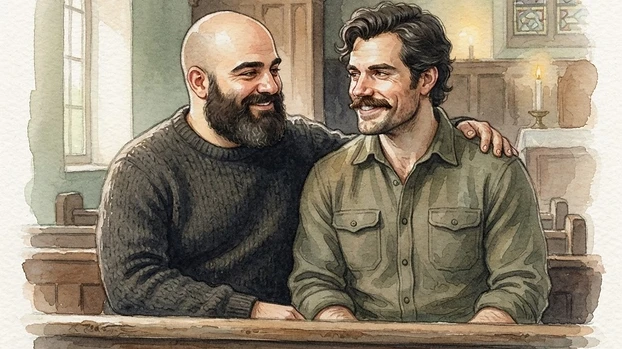
At the relief site, Gruff woke before sunrise on a folding cot inside the church gymnasium.
Dozens of volunteers slept around him.
Rain struck the patched roof.
Somewhere in the darkness, a man snored with the force of construction equipment.
Brute lay on the cot beside Gruff, wrapped inside an emergency blanket that crackled whenever he breathed.
Without opening his eyes, Brute said, “The porcelain Jesus is judging me.”
Gruff looked across the gymnasium.
A painted statue stood near the doors.
“He ain’t porcelain.”
“Then what is he?”
“Plaster.”
“That is worse. Plaster knows things.”
Gruff sat up.
His back cracked loudly.
Brute opened one eye.
“You okay?”
“Fine.”
“Your spine just filed a complaint.”
Gruff stood and reached for his boots.
“Do you ever wake up and think, ‘Today, I will rest’?”
“No.”
“Have you considered it?”
“No.”
“Would you consider considering it?”
Gruff looked at him.
Brute sighed and sat up.
“I hate that face.”
By six o’clock, the mobile kitchen was active.
Eggs cooked on flat-top grills. Grits simmered in deep pots. Volunteers assembled fruit cups, poured coffee, and carried meals to people unable to stand in line.
Gruff moved constantly.
He corrected temperatures, changed contaminated utensils, found a chair for an elderly man, prepared allergy-safe food for a child, and arranged strawberries into a smiling face for a little girl who had refused to eat.
At ten, Brute found him unloading another pallet of water.
“You have volunteers.”
Gruff continued lifting.
“Yes,” Brute said. “But why allow volunteers to volunteer when you can personally damage every disc in your back?”
Gruff set down a case.
“Go check propane.”
“I checked it.”
“Check again.”
“Your concern for propane feels suspiciously like an attempt to remove me.”
Gruff lifted another case.
Brute took it from him.
For a moment, they held opposite ends.
“Let go,” Gruff said.
“No.”
“Brute.”
“No, Gruff.”
“You’re causin’ a scene.”
“Good. Maybe the scene will convince you leadership does not mean doing every job.”
Gruff’s jaw tightened.
Brute lowered his voice.
“I came here to help people. Not to watch you grind yourself into paste.”
“I’m fine.”
“You are one dramatic lift away from becoming part of the mashed potatoes.”
Gruff nearly smiled.
Brute saw it.
“Go cook. Frighten the lentils. Point at someone. Do what you do.”
Gruff released the case.
Brute nodded.
“Good boy.”
Gruff slapped the back of his head.
“There is my reward.”
Later, Brute worked the serving line.
To Theresa and Freddy, Brute was Baba.
At the relief site, he became something similar for everyone.
He greeted each person as though they were arriving at a family picnic instead of a disaster camp. He teased children, complimented grandmothers, remembered names, and convinced a frightened boy to speak by pretending the serving spoon was a microphone.
Gruff watched from the grill.
Brute caught him staring.
“What?”
Gruff shook his head.
“What does that mean?”
Gruff returned to the food.
Brute pointed at himself.
“Am I beautiful?”
Gruff gave him a thumbs-down.
“Jealousy is ugly on you.”
When the line thinned, Brute joined Gruff beside the grill.
“You were smiling at me.”
“Was not.”
“You admire me.”
“Gas fumes.”
“You are deeply moved by my natural charisma.”
“Heat exhaustion.”
“You love me.”
Gruff turned the chicken.
“Natural somethin’.”
Brute leaned closer.
“Say it with the accent.”
Gruff elbowed him away.