The Disaster Zone
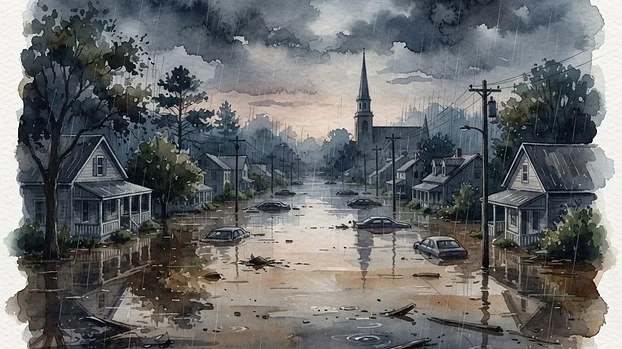
By the time the convoy reached the damaged region, daylight had begun to drain from the sky.
Evidence of the hurricane appeared gradually.
First came road signs twisted in the wrong directions. Then trees stripped of branches. Power lines sagged across empty fields. Billboards had been peeled down to metal frames.
Blue tarps covered scattered rooftops.
Farther south, the damage grew worse.
Entire neighborhoods looked as though a giant hand had swept across them. Walls stood without roofs. Roofs lay in yards without houses beneath them. Cars rested inside drainage ditches filled with muddy water. Clothing hung from tree branches twenty feet above the ground.
Gruff stopped joking.
His shoulders went rigid. His eyes moved constantly.
The convoy finally reached a relief site established in the parking lot of a damaged church. Folding tables stood beneath canvas shelters. Volunteers directed vehicles around pallets of water, diapers, cleaning supplies, blankets, canned goods, and medical equipment.
A handwritten sign identified one entrance as a temporary clinic.
Another pointed toward showers.
Part of the church roof was missing.
Brute stepped out and stared.
“Damn.”
Gruff was already moving.
He found Marisol, the site coordinator, whose reflective vest was stained with mud. Within minutes, he had mapped the kitchen area, checked the propane, and marked the worst sanitation risks for immediate repair.
Marisol stared at the laminated chart in his hands, rain dripping from the brim of her cap.
“You brought a plan?”
Gruff nodded.
“You have not even unloaded,” Marisol said, but her voice had shifted from disbelief toward relief.
He looked toward the disorganized burners and boxes.
“Plan came first,” Gruff said, already looking past her to the burners, boxes, and mud.
His accent had disappeared again, replaced by the careful voice he used around strangers.
Marisol unfolded the chart.
Brute leaned toward Marisol and lowered his voice. “He has plans for his plans. Some of them have emergency contacts.”
Gruff pointed toward the truck.
“Yes, boss,” Brute said, already backing toward the truck.
Gruff divided the chaos into stations: storage, prep, cooking, service, washing, waste. Then he posted allergy notices where everyone had to see them and gave each volunteer a job that matched what they actually knew how to do.
When one man claimed he could cook because he owned a grill, Gruff placed him in charge of trash.
By nightfall, the parking lot had a functioning mobile kitchen.
A family arrived while Gruff tested the burners.
The mother carried a baby against her chest. Two barefoot children followed her, both streaked with dried mud.
She asked whether there was food.
Gruff looked at the empty service line.
The first official meal was not scheduled until morning.
He opened a container, found bread, cheese, applesauce, turkey, and fruit, then began assembling sandwiches.
Brute watched him make four.
Then eight.
Then twelve.
“How many people are with you?” Brute asked the woman.
“Seven. My sister and her children are in the car.”
Gruff made twenty sandwiches.
The woman began crying.
“I’m sorry,” she said, wiping her face. “I don’t know why I’m crying over sandwiches.”
Gruff stopped.
He put the knife down, walked around the table, and opened his arms.
The woman stepped into them.
Gruff held her while she cried against his shoulder.
Brute looked away, offering them privacy.
When Gruff returned to the table, he packed the sandwiches with fruit, wipes, bottled water, and two candy bars for each child.
Marisol had watched from across the parking lot.
“You do this often?” Marisol asked, watching Gruff return to the table as if he had merely adjusted a burner instead of held a stranger together for a minute.
Gruff nodded.
“Disaster relief?”
He shook his head.
“Feeding people?”
He nodded again.
“Professionally?”
Gruff considered the question.
“Personally,” Gruff said, and the word closed something before Marisol could ask what it had cost him.