The Healer of Foods
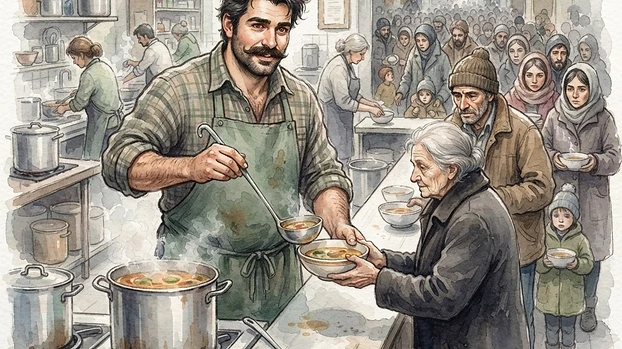
While Gruff and Brute drove south, life at the townhouse settled into Sum-ma’s hands.
She opened every cabinet.
She sniffed the rice.
She tasted the olive oil.
She held a potato beneath the light as though attempting to determine whether it had lived honestly.
Freddy followed her with a bowl of cereal.
“What are you doing?” Freddy asked, trailing her with his cereal bowl like an underqualified assistant.
“Learning the house,” Sum-ma said, sniffing the rice with priestly seriousness.
“You can learn a house from a potato?”
“You can learn everything from a potato.”
“What does that one say?”
Sum-ma turned the potato in her hand. “It says Gruff buys produce in quantities appropriate for wartime.”
Theresa entered wearing one of Gruff’s old shirts. It hung almost to her knees.
“What are we eating?”
“Food,” Sum-ma said, opening the refrigerator like it contained prophecy.
“What kind?”
“The healing kind,” Sum-ma said.
Freddy looked into his cereal. “Is this healing?”
“That depends. Are you injured?”
“No.”
“Then it is preventive medicine.”
Sum-ma found what she needed quickly: onions, garlic, ginger, lentils, sweet potatoes, greens, lemons, and containers of broth labeled in Gruff’s precise handwriting.
She placed everything on the counter.
Theresa studied the ingredients.
“That looks healthy.”
Theresa said healthy the way other people said contagious, then glanced toward the pantry as if escape snacks might still be possible.
“Food should do more than stop hunger,” Sum-ma said, her knife slowing. “It should remind your body that somebody cares whether it keeps going.”
“Gruff says food is a promise,” Freddy said.
Sum-ma paused.
“He does?”
Freddy nodded. “He says when you feed someone, you promise they matter long enough to eat.”
Sum-ma looked down at the vegetables.
“That sounds like him.”
Theresa climbed onto a stool.
“You knew him before he was Gruff.”
“I did.”
“What was he like?”
Sum-ma picked up a knife.
“Loud.”
Both children stared at her.
“Gruff?” Freddy asked.
“Your Gruff. The man who now communicates by pointing at objects like a disappointed traffic officer.”
“He talked a lot?” Theresa asked.
“He sang in kitchens.”
“He sings?”
“Badly.”
Theresa narrowed her eyes. “I don’t believe you.”
“He sang Dolly Parton while cutting onions.”
“Everyone should sing Dolly Parton while cutting onions,” Sum-ma added. “The onions provide plausible deniability for tears.”
“What does that mean?” Freddy asked.
“It means adults disguise feelings with vegetables.”
Theresa leaned forward.
“Tell us how you met.”
Sum-ma smiled.
She chopped the onions, every stroke of the knife falling into a steady rhythm.
“I met Gruff during a dinner service from hell.”
“Was there fire?” Freddy asked.
“There is always fire in a restaurant kitchen. Most of it is intentional.”
“Was Gruff the chef?”
“He was trying very hard to become one.”
Sum-ma swept the onions into a pot.
“The restaurant was packed. Two cooks called off. The dishwasher disappeared, possibly into another dimension, and someone stored raw chicken above the desserts. Gruff was approximately three seconds away from committing homicide with a meat thermometer.”
“Did he?” Theresa asked.
“No. The thermometer was digital, and he respected equipment.”
Sum-ma added oil.
“I had been hired as a server, but the kitchen was drowning. Plates were everywhere. Orders were missing. A grown man was crying beside the walk-in cooler. So I tied up my dress, put on an apron, and started helping.”
“You knew how to cook?” Freddy asked.
“I knew how to listen to food.”
“Food doesn’t talk,” Theresa said.
“Everything talks. Food simply has better manners than people.”
She stirred the onions.
“Gruff saw me reaching across his station and shouted, ‘Ma’am, get your hands off my cutting board.’”
She dropped her voice into an exaggerated imitation of Gruff’s accent.
Freddy burst out laughing.
“He doesn’t sound like that,” Theresa said.
“Oh, he did. He sounded like a Southern church deacon who had discovered sin in the coleslaw.”
“What did you do?”
“I told him the cutting board was not wearing a wedding ring.”
Freddy frowned.
Theresa whispered, “Adult humor.”
Freddy nodded again.
Sum-ma continued.
“I helped him finish the dinner service. Afterward, he made me cornbread as an apology.”
“Why did he apologize?”
“For shouting.”
“He still points at people,” Theresa said.
“Yes, but pointing is silent shouting.”
The onions softened, sweetening the air.
“After that night, we became friends. I taught him that rosemary can wake memories, ginger can settle a troubled stomach, mint can cool heat, and food can carry healing without tasting like medicine.”
“What did he teach you?” Theresa asked.
“How to make biscuits, break down a chicken, organize a pantry, and terrify lazy cooks with one raised eyebrow.”
“Did he dance?” Freddy asked.
Sum-ma smiled slowly.
“Only when he believed no one was watching.”
“What kind?”
“Badly.”
“That is not a kind.”
“For Gruff, it was.”
Sum-ma added garlic and ginger.
“Tonight, I will tell you one of the old traveling stories he used to tell me. The story of the woman who carried the moon in a cooking pot.”
“Is it true?” Freddy asked.
Sum-ma considered him.
“Old stories are not always required to be true. They are required to know something.”