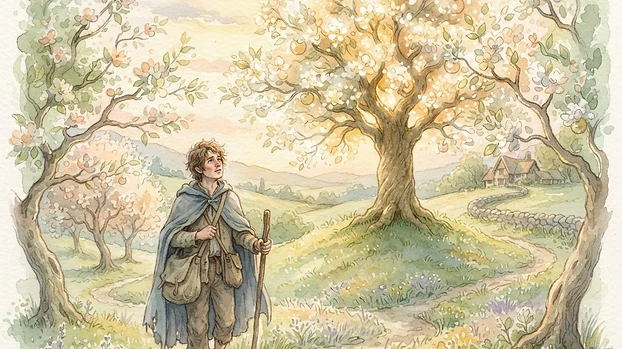
The Orchard That Remembered His Name
Rain moved gently across the townhouse windows.
It no longer struck the glass with the wild urgency of the earlier storm. Now it came in long, whispering passes, as though the clouds were dragging their fingertips along the roof before moving on.
Theresa was tucked beneath the quilt, but sleep stayed just out of reach. Her eyes remained wide open, listening to the rain as if it were trying to tell her something she was too small to understand.
Freddy lay beside her with his head resting at the wrong end of the bed, one foot planted against the wall and the other hanging over the edge.
Sum-ma looked at him.
“Is there a reason you are sleeping like a fallen scarecrow?”
“My brain sleeps better this way.”
“Your brain has questionable interior-design skills.”
Theresa giggled.
Sum-ma sat cross-legged on the rug rather than returning to the chair. She had removed her shoes, wrapped her dark floral shawl around her shoulders, and placed three warm mugs on the floor beside her.
The children’s mugs held chamomile tea sweetened with honey and a little apple peel. Sum-ma’s was darker and smelled faintly of cacao, cinnamon, and something green that Freddy insisted was probably a weed.
“It is not a weed,” Sum-ma had told him.
“What is it?”
“A plant whose name you would mispronounce and then blame on me.”
Freddy had accepted this explanation.
The old book containing the story of Harap-Alb remained closed beside her. Theresa glanced toward it.
“One more story?”
Sum-ma lifted one eyebrow.
“The ancient bedtime negotiation begins.”
“Please?”
“You said that very sweetly. Suspiciously sweetly.”
Freddy rolled onto his stomach.
“One more Romanian story. Then we will definitely go to sleep.”
“Children who announce that they will definitely sleep are like politicians announcing that they will definitely tell the truth.”
Theresa did not understand the joke, but Sum-ma smiled to herself.
For a moment, the townhouse held all of them in its small circle of warmth: the mugs, the quilt, the rain, and the question none of them wanted to say aloud.
Far to the south, beyond the townhouse, beyond the highway and the sleeping farms, the rain was not gentle.
It drove sideways across a flooded town, turning the night into a wall of black water.
Gruff and Brute remained stranded on the roof of a damaged building.
The flood had swallowed the first floor hours ago. Water pushed through broken windows and carried pieces of people’s lives down the street: a dining chair where someone had once eaten breakfast, a child’s red wagon, torn branches, siding, a refrigerator door that turned slowly in the current like a thing searching for home.
The roof beneath the men groaned whenever the wind changed direction.
Gruff crouched beside a bent ventilation pipe, one hand pressed against the shingles. He was not merely touching the roof. He was listening through it.
Brute watched him.
“What are you doing?”
“Feeling where the support beams are.”
“You can feel that?”
“I can feel where the roof shakes less.”
“That does not sound scientific.”
“Neither does standing in floodwater and arguing with the person trying to keep you alive.”
Brute looked out over the darkness.
No rescue boats were visible.
No helicopter could safely fly in the wind.
The only lights came from distant flashes of lightning.
Far from Sum-ma’s warm room, the night was asking the same lesson in a harsher voice.
The same rain that whispered at Theresa’s window struck this roof like thrown gravel, turning comfort into danger without changing its name.
Inside the townhouse, Sum-ma placed one hand against the wooden floor.
“Before another story,” she said, “we help our bodies understand where we are.”
Freddy stared at her hand.
“We are in the townhouse.”
“Your thinking mind knows that. The older parts of your brain do not always listen to speeches.”
She patted the rug.
“Feel what is holding you.”
Theresa pressed her palm against the mattress.
Freddy pushed both feet into the wall.
“The wall is holding me,” he said.
“The wall would prefer that you not test its commitment.”
Sum-ma placed her hand over her heart.
“Now notice one sound inside the room.”
“The clock,” Theresa said.
“The rain,” said Freddy.
“That is outside.”
“It sounds inside.”
“Fair argument.”
Sum-ma drew a slow breath through her nose and released it with a soft humming sound. The note vibrated warmly through the room.
Theresa copied her.
Freddy’s hum came out low and dramatic, like a ship horn.
Sum-ma opened one eye.
“Are you calming your nervous system or summoning fishing vessels?”
“I do not know yet.”
They hummed again.
“When we feel frightened,” Sum-ma told them, “our bodies try to protect us. Sometimes the alarm becomes louder than the danger. We do not become angry with the alarm. We thank it for trying, then we help it listen.”
“How?” Theresa asked.
“By giving it something true. The bed is beneath you. The room is warm. You can hear my voice. You are not alone.”
Theresa relaxed farther into the pillow.
Sum-ma reached for one of the mugs.
What she offered them as comfort was also a kind of map: listen first, find what is holding you, then choose the next small thing.
“Now,” she said, “I will tell you about a boy whose greatest power was noticing what everyone else ignored.”
Freddy raised his head.
“Did Gruff teach you this one too?”
“Yes.”
“Did he growl while telling it?”
“Frequently. He also objected to several portions and attempted to rewrite the ending.”
“What was wrong with the ending?”
“Gruff believes nearly every story would improve if the characters carried emergency rope.”
The joke made Freddy smile, but it also tied the room to the storm beyond it; in one place, rope was part of a story, and in another, rope was all that might keep someone from being swept away.
Far away, on the flooded roof, Gruff checked the length of wet rope still looped around his shoulder.
Not enough to reach another building.
Enough, perhaps, to keep Brute from being taken if part of the roof gave way.
Sum-ma took a sip from her mug.
“Long ago,” she began, “there lived an emperor who possessed a magnificent orchard. Pears grew there as sweet as summer rain. Plum trees bent beneath purple fruit, and white blossoms covered the cherry branches each spring.
“But in the center of the orchard stood one tree unlike all the others.
“It bore apples of gold.”
“Real gold?” Freddy asked.
“Golden enough to attract trouble, which is usually the important part.”
Every year, the emperor watched the apples grow. Yet each time they became ripe, someone entered the orchard during the night and stole them.
He sent guards.
They fell asleep.
He sent hunters.
They heard nothing.
He sent men who boasted that they had never been frightened in their lives.
Those men became frightened before sunset and spent the night blaming one another.
The emperor’s two eldest sons volunteered to guard the tree.
The first arrived wearing heavy armor. He marched around the orchard, striking his sword against his shield to prove that he was awake.
“Did it work?” Theresa asked.
“It worked beautifully for informing the thief exactly where he was.”
At midnight, the prince grew tired. He sat beneath the tree and fell asleep.
By morning, the apples were gone.
The second son tried the following night. He ordered servants to bring torches, drums, food, and a chair large enough to resemble a small throne.
“He believed discomfort was the problem,” Sum-ma explained. “Sometimes people surround themselves with more and more things because they are frightened of being alone with their own thoughts.”
He also fell asleep.
Then the youngest son, Prâslea, went to his father.
“I would like to guard the tree,” he said.
His father sighed.
“You are young.”
“Yes.”
“Your brothers are stronger.”
“Yes.”
“Experienced soldiers have failed.”
“Yes.”
The emperor became irritated.
“Have you nothing more useful to say?”
“I have been listening.”
That answer surprised the emperor.
Prâslea had noticed that the apples were never stolen on windy nights. He had noticed claw marks on the side of the tree and a strange smell in the soil after each theft. He had seen that the birds stopped singing shortly before midnight.
His brothers had watched for an enemy.
Prâslea watched for a pattern.
Sum-ma leaned toward the children.
“Some minds notice what others walk past. A shift in sound. A repeated shape. A change in someone’s voice. A detail that does not belong.”
Theresa smiled.
“Like Gruff.”
“Very much like Gruff.”
“Is that why he knows when we sneak cookies?”
“No. The crumbs on your shirts perform most of that work.”
On his night in the orchard, Prâslea did not spend the day exhausting himself with worry. He ate a good meal. He rested. He walked beneath the trees and learned where every root rose from the ground.
He listened to the bees returning to their hives.
He watched the moon climb.
When darkness came, he sat beneath the golden tree and breathed with the orchard.
The branches moved.
His breath moved.
The clouds passed.
His thoughts passed.
He did not need to chase every sound.
He waited until the true sound arrived.
Just before midnight, every cricket became silent.
Prâslea stood.
A shadow dropped from the sky.
The creature that entered the orchard was a zmeu, a powerful being from the hidden world. It reached for the golden apples.
Prâslea fired an arrow.
The zmeu cried out and escaped, but drops of blood marked a trail beyond the palace walls.
By morning, several golden apples still hung from the tree.
The emperor held one in his hands and wept because he had never before tasted the fruit of his own orchard.
“You succeeded,” he told his youngest son.
“Not yet,” Prâslea answered. “The creature will return unless we understand where it came from.”
Prâslea and his brothers followed the trail until it ended beside a deep opening in the earth.
The brothers looked into the darkness.
“I will go first,” the eldest announced.
He was lowered only a short distance before shouting to be pulled back.
The second descended a little farther, then demanded the same.
Prâslea tied the rope around himself.
“What if you cannot find the bottom?” his brothers asked.
“Then I will learn something about the depth.”
“What if something waits below?”
“Then refusing to look will not make it disappear.”
Sum-ma paused and held up one finger.
“Now, that does not mean leaping into every dark hole you find.”
Freddy looked disappointed.
“It means there are moments when fear gives us information. It tells us to prepare. It tells us to pay attention. But fear is an alarm, not a prophecy.”
Those words seemed to settle over the children, but far away they had another shape: not a bedtime lesson, but survival.
Far away, Gruff felt Brute beginning to shake beside him.
The wind had strengthened.
Brute stared at the water below.
“I cannot stop thinking about the building collapsing,” Brute said, and the words came out smaller than he meant them to. He hated how young he sounded. He hated that the dark water below seemed to be waiting for him to admit he was afraid.
“Then stop trying not to think about it,” Gruff said.
Brute looked at him.
“What?”
“Your mind is sounding an alarm. Give it work.”
Gruff pointed toward the eastern edge of the roof.
“Tell me what you see.”
“Water.”
“More specific.”
“Debris moving north.”
“Good. What do you hear?”
“Wind. Metal banging somewhere.”
“Again.”
Brute listened.
“A motor.”
Gruff turned his head.
It was faint, nearly lost beneath the storm.
But it was there.
“Good,” he said.
“Is it a rescue boat?”
“Insufficient information.”
Brute almost laughed.
The sound disappeared again.
And as the motor faded into the storm again, the story in the townhouse descended into its own darkness.
The alarm in Brute’s body had not vanished, but it had been given something true to hold: water moving north, metal in the wind, a sound that might become help.
Inside the townhouse, Sum-ma continued.
Prâslea descended through the opening and entered a world beneath the world.
He found three palaces: one of copper, one of silver, and one of gold. In each palace, a princess was held captive by a zmeu.
Prâslea fought bravely, but strength alone did not save him.
He listened when the princesses warned him.
He rested when his body weakened.
He accepted help.
At the golden palace, the youngest princess told him that the most powerful zmeu could not be defeated through force alone.
“He grows stronger when you become angry,” she explained. “He wants you to forget yourself.”
“What did Prâslea do?” Theresa asked.
“He remembered the orchard.”
During the battle, he felt rage rising through him. His vision narrowed. His breath became shallow. The zmeu grew larger.
Prâslea pressed his foot against the earth.
He noticed the ground beneath him.
He heard the princess’s voice.
He felt his heart beating.
Then he remembered why he had come.
Not for glory.
Not to prove he was stronger than his brothers.
He had come to protect his home and return what had been taken.
His breathing steadied.
The zmeu became smaller.
Prâslea defeated him.
“He calmed himself in the middle of a fight?” Freddy asked.
“He came back to himself,” Sum-ma corrected. “Calm does not always mean quiet. Sometimes calm means knowing precisely where to place your strength.”
Prâslea brought the three princesses to the opening and sent them up one at a time.
His brothers pulled each woman safely into the upper world.
But jealousy had grown in their hearts.
They knew that when Prâslea returned, everyone would learn who had truly completed the journey.
Prâslea sensed that something had changed. He tied a heavy stone to the rope and placed his cap upon it.
His brothers believed it was him.
They released the rope.
The stone crashed into the darkness below.
Theresa’s mouth fell open.
“They tried to kill him?”
“They tried to erase him,” Sum-ma said. “Some people believe that hiding another person’s light will make their own burn brighter.”
“What did Prâslea do?”
“He grieved.”
The children became still.
“He did not pretend that betrayal did not hurt. He did not call pain weakness. He sat upon the earth and allowed himself to feel what had happened.”
Sum-ma touched the center of her chest.
“Feelings move when we give them room. When we lock them away, they begin rearranging the furniture.”
Freddy glanced suspiciously around the room.
“That is not literal.”
“Usually.”
Prâslea wandered through the lower world searching for another way home.
One day, he heard terrified cries above him.
A great serpent was climbing a tree toward the nest of a giant bird. Inside the nest were three young chicks.
Prâslea fought the serpent and saved them.
When their mother returned, her wings covered the sky.
At first she was furious to find a human near her nest.
Then her chicks told her what he had done.
“You protected my children when no one was watching,” the great bird said. “Tell me what you need.”
“I need to return to the world above.”
“That journey will be difficult.”
“I know.”
“You may become afraid.”
“I already am.”
The bird studied him.
“Then climb upon my back.”
Prâslea gathered bread and water for the journey. Whenever the great bird tired, he fed her. Whenever she became thirsty, he gave her water.
They rose through the darkness together.
Higher and higher they flew until Prâslea finally saw daylight.
“The bird saved him because he saved her babies,” Theresa said.
“Yes, but he did not protect them to earn a reward. Kindness is not a vending machine. We do not insert one good deed and demand a prize.”
Freddy raised his hand from beneath the quilt.
“What is a vending machine?”
“A metal cabinet that eats money and occasionally gives you stale crackers.”
Prâslea returned to his father’s kingdom dressed as an ordinary traveler.
He discovered that his brothers had claimed his victories as their own. The two older princesses had been married, but the youngest still refused every offer.
She knew Prâslea was alive.
“How?” Theresa asked.
“Faith.”
“But she did not have proof.”
“Faith and proof are different medicines,” Sum-ma said. “Proof tells us what has already appeared. Faith helps us remain open to what has not arrived yet.”
Prâslea eventually revealed himself through the golden objects he had brought from the hidden world.
The youngest princess recognized him.
His parents recognized him.
Even the orchard seemed to recognize him, for the golden tree blossomed when he entered the garden.
His brothers waited for punishment.
Prâslea could have destroyed them.
Instead, he allowed the truth to stand before everyone.
Their own choices revealed who they had become.
Prâslea married the youngest princess and eventually became emperor—not because he was the strongest son, but because he had learned how to listen.
He listened to the orchard.
He listened to his fear without obeying it blindly.
He listened to those who offered wisdom.
He listened to his grief.
And when the world tried to take his name, he listened closely enough to remember it.
The tale had traveled underground and back into daylight, but its echo remained in the room: listen, remember, return.
Sum-ma fell silent.
The rain whispered against the townhouse.
Theresa looked toward the small plant on the windowsill. Its leaves trembled whenever air moved from the heating vent.
“Do plants really remember things?” she asked.
“In their own way,” Sum-ma said. “They remember where the light comes from. They remember when to open and when to rest. Roots remember how to move around stone.”
“Do people remember like roots?”
“Sometimes. Even when your thinking mind becomes lost, another part of you may still lean toward the light.”
Freddy’s eyes had begun to close.
“Did Gruff say that?”
“No. Gruff said, ‘A tree does not waste time arguing with a rock. It grows around it.’”
“That sounds more like Gruff,” Theresa said.
Sum-ma smiled.
“What did he say about the golden apples?” Theresa asked.
“He said they represented the parts of ourselves that fear keeps stealing.”
“What parts?”
“Our voice. Our joy. Our trust. The strange little gifts we hide because someone once made us feel ashamed of them.”
Theresa thought about this.
“And Prâslea took them back?”
“He remembered that they had always belonged to him.”
Sum-ma rose from the rug and moved her arms slowly through the air, one curving above her head while the other extended toward the floor.
The motion was part dance and part stretch, smooth as a branch bending in warm wind.
Freddy opened one eye.
“What are you doing?”
“Returning my spine to the land of the living.”
She swayed once, turned, and pulled the quilt over his dangling foot.
Then she placed one hand lightly over Theresa’s heart.
“You have a brilliant mind,” she said. “But you do not have to solve the entire world before sleeping.”
She placed her other hand over Freddy’s blanket-covered back.
“And your body is allowed to rest before it has answered every alarm.”
“Even fake alarms?” he mumbled.
“Especially those.”
“Will Gruff come home soon?” Theresa asked, and the question was so soft it seemed afraid of the answer.
Sum-ma looked toward the rain-darkened window.
She did not know about the floodwater.
She did not know about the damaged building or the roof bending beneath Gruff and Brute.
She did not know that, far away, the motor had become audible again.
Her heart carried no warning.
Only love.
“He will find the path,” she said, and because she loved him, she made the words steady. She offered them to Theresa like a blanket, though something in her own chest tightened around the silence after his name.
The words stayed in the room after she said them, and somewhere beyond the rain they seemed to become a thread pulled taut through the dark.
Far to the south, Brute lifted his head.
“There,” he whispered.
Between sheets of rain, a small white light appeared beyond the flooded buildings. It was so faint that Brute almost feared looking at it too hard would make it vanish.
It moved once.
Disappeared.
Then returned.
Gruff watched its pattern.
Three slow flashes.
A pause.
Three more.
Not lightning.
Not a house.
Someone was searching.
Brute began to stand, but Gruff caught his coat and pulled him back down.
“Careful.”
“They found us.”
“They might have.”
“You always do that.”
“Do what?”
“Refuse to sound hopeful.”
Gruff secured the rope around the ventilation pipe.
“Hope is not pretending the roof cannot break,” he said. “Hope is preparing to be seen while it still holds.”
He removed the small flashlight from his pocket.
The battery was weak.
He covered the beam with his hand and began answering the distant light, each flash costing a little more of the battery and giving a little more of himself to the dark.
Three flashes.
A pause.
Three more.
Inside the townhouse, Sum-ma lowered the lamp.
Theresa had finally closed her eyes.
Freddy was already asleep, one hand curled beneath his cheek, his body finally trusting the room enough to let go.
Sum-ma stood beside the window for a moment, listening to the quieter rain. Then she touched two fingers to her lips and pressed them gently against the glass, as if the cold pane could carry warmth farther than her hands could reach.
“For the travelers,” she whispered.
She did not know why she said it.
Perhaps it was habit.
Perhaps love sometimes moved before knowledge.
Far away, the rescue light disappeared behind the storm again.
Gruff kept watching.
Brute remained beside him.
The water continued rising.
The roof continued holding.
And somewhere between fear and faith, two small lights searched for one another through the dark, stubborn and trembling, as if love itself had become a signal no storm could quite erase.