The Roof
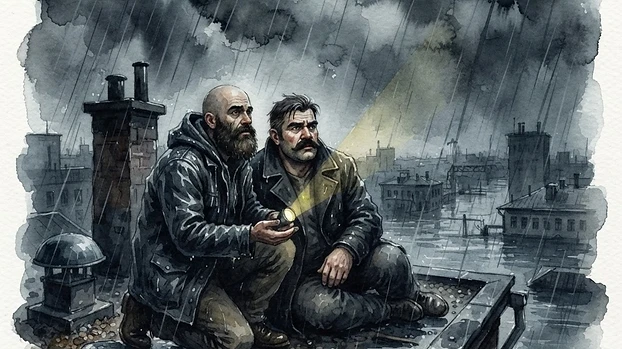
On the flooded roof, Gruff turned the weather radio’s crank.
Static burst through the speaker.
He adjusted the frequency.
A warning voice emerged in broken pieces.
“—flash flood emergency remains in effect—”
Static.
“—structures should not be considered stable—”
Static.
“—additional rainfall—”
Brute leaned close.
“Tell me it says rescue is still moving,” Brute said.
The radio continued.
“—rescue operations suspended in some areas due to lightning and extreme wind—”
Brute nodded.
Brute went still.
Tasha lay flat near the vent pipe, pressing gauze against a cut on her forehead.
Mr. Alvarez stared toward the submerged neighborhood.
“My daughter should be at the high school shelter,” he said. “She left before the second storm.”
“Then she’s above flood level,” Tasha said.
Mr. Alvarez nodded, but his eyes remained fixed on the water.
Gruff examined Brute’s shoulder.
A long scrape ran from the top of the arm toward his back.
“No deep cut,” Gruff said.
“Good,” Brute said, though his voice shook. “Good. That means I can keep using it.”
Gruff cleaned it with bottled water and antiseptic.
Brute hissed.
“Warn me next time,” Brute said through his teeth.
“I said I was cleanin’ it.”
“I need to know before pain hits.”
Tasha looked toward them.
Tasha looked between them. “You two always talk like this when you’re scared?”
Brute glanced at Gruff.
Brute glanced at Gruff. “Only when we’re trying not to be.”
Gruff taped gauze over the scrape.
“Neither.”
Brute placed one hand over his heart.
Brute looked at the flood beyond the roof. “I thought we were gone back there.”
“You did not carry me.”
Gruff finished the tape. “We weren’t.”
“You fell on me.”
“Barely,” Brute said.
Mr. Alvarez gave a tired laugh.
The sound surprised all of them.
Brute pointed toward him.
Brute let the silence stay this time.
Wind struck the roof again.
The rope tightened between them.
Gruff dropped lower.
A piece of corrugated metal flew over the neighboring house, spinning through the air before disappearing into the flood.
Tasha looked toward the sky.
“How long can this last?”
Gruff did not answer.
The rain had changed.
Its direction shifted every few minutes, indicating unstable rotation. Water continued rising against the house, but the current near the back had become more violent.
Gruff felt vibration through the shingles.
He placed one palm flat against the roof.
Brute noticed.
“What?”
Gruff remained still.
The house shuddered again.
Not wind.
Something below had moved.
“Lee?”
“Foundation.”
Mr. Alvarez’s face tightened.
“This house is on a crawl space.”
“Water’s pushin’ underneath.”
“Can it lift the house?”
Gruff looked toward him.
“Maybe.”
Brute stared.
Brute stared. “Say that again.”
Gruff crawled toward the roof ridge.
“Everybody higher.”
They moved carefully, staying attached to the rope.
At the ridge, Gruff opened an emergency blanket and cut it into long strips.
Brute watched.
“What are you making?” Brute asked.
“Signal.”
Gruff tied the reflective material to the fallen television antenna, creating a bright silver flag.
Tasha activated two glow sticks and secured them near the roof peak.
Mr. Alvarez used the whistle in repeated bursts.
Three short.
Pause.
Three short.
The storm answered with thunder.
In the distance, a rescue boat’s spotlight moved between the houses.
Tasha sat up.
“There!”
Gruff grabbed the flashlight and signaled.
Three flashes.
Pause.
Three flashes.
The boat turned toward them.
Brute began waving both arms.
“Over here!”
The spotlight crossed the roof.
For a moment, it held directly on them.
“They see us!” Mr. Alvarez shouted.
The rescue boat moved closer.
Then a surge of floodwater rushed down the street.
It carried a detached garage door, several tree limbs, and part of a wooden porch.
The boat turned sideways to avoid the debris.
Its spotlight vanished behind a house.
They waited.
It did not reappear.
Brute lowered his arms.
For a few seconds, Brute kept his arms raised even after there was nothing left to wave at. Rain ran from his sleeves in steady streams. His hands stayed open, fingers spread toward the empty place where the light had been, as if the shape of his need could pull the boat back.
“They have to come back,” Brute said.
No one answered.
His voice did not rise. That made it worse. The panic had dropped beneath shouting now, down into something thin and stunned.
“Lee, they saw us.”
Gruff watched the place where the light had disappeared.
“They saw us.”
Gruff kept his eyes on the flooded street. He could still picture the boat’s last angle, the hard turn of its bow, the way the spotlight had vanished behind the black shoulder of the neighboring house. Seeing was not the same as knowing. Not tonight.
“Then why can’t I see the light?”
“Maybe.”
Brute looked at him.
Brute turned slowly toward him. Water dripped from his chin. His mouth tried to make the old shape of a joke and failed before sound reached it.
Brute’s voice dropped. “I can’t do maybe right now.”
Gruff shifted closer, not enough to crowd him, just enough for Brute to feel him there through the rope between them. His hand closed once around the line, steadying both of them.
Gruff looked at him. “Then do breath. One breath at a time.”
The house shifted beneath them.
A long crack passed through the roof.
Mr. Alvarez cried out.
One side of the structure dropped several inches.
Water surged across what had been the front yard.
The rope pulled tight as Tasha slid down the shingles.
Gruff caught the line and wrapped it around his forearm.
Brute grabbed Tasha’s wrist.
Mr. Alvarez held Brute’s belt.
For the second time that night, they became a human chain.
Tasha found her footing and crawled back toward the ridge.
The house settled at a new angle.
Brute breathed heavily.
When the roof stopped sliding, no one moved at first. The rope hummed with their combined weight. Tasha’s breath came in sharp bursts. Mr. Alvarez had both hands locked around the shingles, his knuckles pale beneath the rain. Brute looked down at his own fingers as if surprised they were still attached to something solid.
“I’m still here,” Brute said, more to himself than anyone else.
Gruff looked toward the upstream side of the house.
The water had begun striking it differently.
Instead of dividing around the walls, the current was passing beneath them.
The house was no longer fixed.
It was floating.
“Everybody stay low,” Gruff said.
Brute stared at him.
Brute watched Gruff’s palm on the shingles. He had seen that stillness before: Gruff listening through his skin, reading danger from wood, water, vibration, and pressure. It frightened Brute more than thunder because Gruff only went that quiet when the world had already made a decision.
“What did you feel?” Brute asked.
Gruff did not answer.
“Lee.”
“The house moved.”
Brute’s face changed. “We felt it break?”
“No.”
Gruff looked toward the neighboring roofline.
It had shifted position relative to them.
“We moved.”
Tasha followed his gaze.
Her face went pale.
Mr. Alvarez whispered, “The foundation let go.”
The house turned slowly in the flood.
The roof rotated away from the street and toward a line of trees.
Brute looked at Gruff.
The slow turn of the house made the entire neighborhood seem to move around them. Rooflines slid out of alignment. A mailbox drifted past at eye level. Somewhere beneath them, wood groaned in long, exhausted tones.
Brute looked at Gruff. “Tell me there is another roof.”
“No.”
The answer landed between them with the weight of a closed door. Brute stared at him for one heartbeat, two, then lowered his gaze to the rope around his waist.
Brute swallowed hard. “Okay.”
Gruff almost smiled.
Lightning flashed.
Ahead of them, a massive oak tree had fallen across the flood channel. Water piled against its branches before forcing through in violent streams.
The drifting house was moving directly toward it.
If the structure struck the trunk sideways, the roof could collapse.
Gruff opened the backpack again.
He removed the rope’s unused length, two carabiners, and the folding knife.
Tasha watched him.
“What are you planning?”
“Tree might stop the house.”
Brute looked toward the oak.
“Or it tears us open,” Brute said.
“Maybe.”
Brute nodded once, accepting the shape of it.
“We anchor to the tree if we get close.”
Mr. Alvarez stared at the flood between them and the branches.
“How?”
Gruff tied a large loop.
“Throw line.”
“In this wind?” Tasha asked.
“Need one chance.”
The house rotated faster.
Shingles tore loose and flew into the darkness.
Brute crawled beside Gruff and kept his voice low.
Brute crawled in close enough that their shoulders nearly touched. He did not look at the tree. He looked at Gruff’s hands instead, at the rope moving through them, at the knife, at the knot forming with ugly purpose.
“Tell me what to do.”
Gruff handed him the flashlight.
“Keep the branch lit.”
“I’ll keep it lit.”
“We’re movin’.”
The flashlight beam trembled across the branch, then steadied as Brute locked both hands around it. His breathing stayed uneven, but his eyes fixed on the single bright target Gruff had given him.
“If I lose it, say my name.”
“Then pick one thing.”
Brute aimed the light at the thickest branch extending over the water.
Gruff wrapped the rope around one forearm and measured the distance.
Too far.
The house moved closer.
Water smashed through the attic vents.
Mr. Alvarez shouted, “It’s coming inside!”
The roof sagged.
Gruff waited.
His entire body became still.
The rain.
The rotation.
The movement of the branch.
The drift of the roof.
The rope’s weight.
For one breath, every detail separated.
Clear.
Sharp.
Possible.
“Now,” he whispered.
He threw.
The rope loop opened through the air.
Wind caught it.
For one terrible second, it appeared to fall short.
Then the edge of the loop passed over the branch.
The weighted carabiner dropped around the far side.
Gruff pulled.
The loop tightened.
“Got it!” Tasha shouted.
Gruff clipped the rope into their safety line.
The house struck the outer branches.
Wood exploded.
Everyone flattened against the roof.
The anchored rope snapped tight.
The tree bent but held.
The house stopped rotating.
For a moment, all four remained alive on the roof.
Brute lifted his face from the shingles.
The impact knocked the air out of all of them. For one suspended moment, the roof, the tree, the rope, and the people tied to it seemed to hold the same breath.
“Lee,” Brute said, lifting his face from the shingles.
Gruff stared at the rope.
“You did it.”
A low cracking sound came from the oak.
Gruff’s eyes moved upward.
The branch holding their rope split near the trunk.
“Move!” he shouted.
The branch broke.
The rope whipped free.
The house surged forward.
It struck the main trunk.
The roof buckled beneath them.
Tasha screamed.
Mr. Alvarez slid toward the edge.
Brute caught him.
Gruff’s safety line pulled hard around his waist.
The center of the roof opened with a sound like thunder.
Black attic space appeared beneath the shingles.
The house tilted.
Water poured through the broken structure.
Brute looked toward Gruff.
Brute’s hand found Gruff’s vest before his words did. He gripped the wet fabric hard enough to twist it, not pulling yet, just anchoring himself to the one person still looking for an answer.
“Lee,” Brute said. “Tell me there’s a way.”
Another crack tore across the roof.
Half the house began separating from the rest.
Gruff saw the tree.
The water.
The collapsing roof.
The four bodies tied together.
He saw only one possible direction.
He grabbed Brute’s vest.
“On my word,” Gruff shouted.
Brute’s eyes widened.
Gruff’s hand tightened on Brute’s vest. Not comfort. Not warning. A promise and an apology in the same grip.
Brute’s eyes widened. “Are we going into the water?”
The roof dropped beneath them.
Gruff looked toward the moving flood.
Then he shouted, “Jump!”
And the house disappeared beneath the water.