The Water Remembers
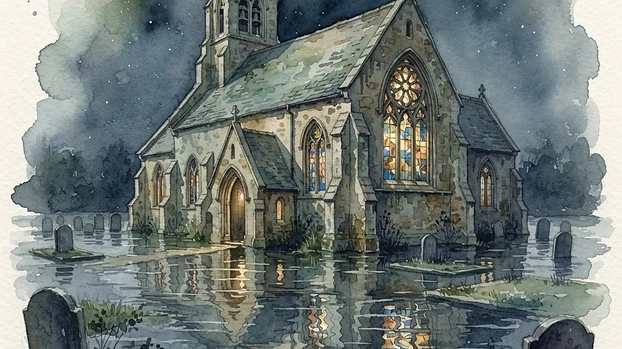
The church doors slammed shut behind Gruff, and for half a second, the storm disappeared.
The roar of the wind became a muffled animal outside the walls. Rain hammered the roof, but inside the church there was only darkness, hurried breathing, crying children, and the pale green glow of emergency signs.
Then the building groaned.
Gruff stopped moving.
Brute nearly collided with him.
“Why’d you stop?” Brute asked, the words smaller than usual. “Lee?”
Gruff did not answer.
His head turned slightly toward the southern wall.
The room around him sharpened.
The room around him sharpened.
At the relief camp, families grabbed bags, children, medicine, and whatever belongings they had recovered. Volunteers directed people toward the church. Hundreds of miles north, rain softened the townhouse windows while Sum-ma carried ginger tea upstairs for Theresa. In both places, the storm had found the people Gruff loved.
But when danger became real, fear stopped being a cloud and became information.
Every sound separated itself from the others.
The screams belonged to frightened people, but one cry near the medical hallway had pain underneath it.
The pounding against the roof was rain, but the deeper strike every few seconds was a loose ventilation panel lifting and falling.
The scraping near the kitchen was a refrigerator sliding slowly across the wet floor.
The hiss beneath the generator room door was water touching something hot.
The vibration beneath Gruff’s boots was not thunder. Water was building against the outside wall.
Brute grabbed Gruff’s shoulder.
“Lee.”
Gruff looked at him.
Brute only used his real name when the joke had left the room.
“Tell me what I’m missing,” Brute said.
Gruff’s eyes moved across the sanctuary.
People had packed themselves between rows of folding chairs. Volunteers were trying to direct families toward the basement stairs, but the hallway was jammed. A woman held a toddler against her chest. Another child had lost one shoe. An elderly man leaned heavily against the wall, unable to keep up with the crowd.
Marisol stood near the front, shouting instructions through a battery-powered megaphone.
“Everybody stay calm! Move toward the center of the building! Do not go near the windows!”
Gruff looked at the southern exit.
A thin line of muddy water crawled beneath the door.
Brute followed his gaze.
“That’s water,” Brute said. The joke never came. “Lee, that’s water coming in.”
The line widened.
Gruff raised his voice.
“Marisol!”
She looked toward him.
“Get them out of the basement. Now.”
Confusion crossed her face.
“The basement is the tornado shelter!”
“Not for what’s coming.”
“We have a warning outside!”
“And the water is already inside.”
Marisol turned toward the basement hallway.
People were already descending the stairs.
Another groan passed through the building.
This time, everyone heard it.
The children stopped crying for one startled second.
The floor trembled.
Brute stared toward the southern exit.
“Lee?”
Gruff pointed toward the upper classrooms on the north side.
“Second floor. Move everybody up.”
Marisol lifted the megaphone.
“Change of plan! Turn around! Everyone out of the basement! We are moving to the second floor!”
The crowd shifted.
Panic moved faster than instructions.
People pushed backward while others continued trying to move forward. Bodies pressed together in the narrow hallway. Someone dropped a bag of medicine. Bottles scattered beneath people’s feet.
Gruff moved toward the congestion.
He climbed onto a folding chair and shouted, “Stop!”
His voice struck the room harder than the thunder.
The Southern accent vanished beneath the command.
Everyone looked toward him.
“Don’t push. Children and medical first. If you can walk, stay against the walls. Give the center aisle to wheelchairs and anybody being carried.”
A man near the basement entrance shouted, “There’s no room!”
“Make room,” Gruff answered.
The man started to argue.
Gruff pointed directly at him.
“You in the blue shirt. Turn around. Take that little girl upstairs.”
The man looked beside him and seemed to notice the child for the first time.
He lifted her.
Gruff pointed toward another volunteer.
“You. Help that gentleman.”
Then another.
“Clear them chairs. Stack ’em against the west wall.”
The crowd began moving again, this time with purpose.
Brute stepped beside Gruff, pale now. “Tell me we’re early.”
Gruff climbed down.
“We ain’t.”
Brute swallowed and looked toward the hallway full of people. “Then we need faster.”
A sharp metallic pop sounded behind them.
The southern door bowed inward.
Not opened.
Bowed.
The metal surface curved under pressure, then returned to shape.
Brute’s face changed. “That door’s losing.”
Gruff grabbed his arm.
“Move. If it gives, it takes the room.”
The door bowed again. The frame cracked. Water burst through the lower corner in a hard, muddy stream.
People screamed.
“Upstairs!” Marisol shouted. “Move!”
The stream widened immediately, racing across the tile floor and carrying leaves, twigs, paper cups, and chunks of insulation.
Gruff looked toward the kitchen.
The refrigerator had begun to float.
“Power off?” he shouted.
A volunteer answered from the generator room. “Main line is down! Backup’s disconnected!”
Gruff watched the water.
It reached the first row of chairs in seconds.
There was too much of it.
This was not water leaking into a building.
This was a river searching for a new direction.
Two young children stood near the kitchen doorway, separated from the adults moving toward the stairs. A little boy, no older than six, held the wrist of a girl who looked four. Both were crying.
Their mother was somewhere across the room screaming their names.
“Mason!”
“Ellie!”
The children tried to move toward the voice.
The rushing water knocked Ellie down.
Gruff reached her before her face struck the floor.
He caught the back of her shirt with one hand and lifted her against his chest. With his other arm, he swept Mason off his feet.
“I got you,” Gruff said.
Ellie screamed and grabbed his neck.
Mason kicked in panic.
“Where’s my mom?”
“We’re findin’ her.”
“Where is she?”
Gruff looked across the room.
The mother was trapped on the far side of the widening current. Two volunteers held her back as she tried to cross.
“My babies!”
Gruff lifted his chin toward the second-floor landing.
“Get up there!” he shouted to her. “I’ll bring ’em!”
A deafening crack split through the sanctuary.
The southern doors tore inward.
Water exploded into the church.
It struck the first rows of chairs and sent them sliding. Folding tables lifted and turned. Boxes of supplies burst apart. Cans rolled through the room like metal stones.
The current hit Gruff at the knees.
He widened his stance.
His mind calculated before fear could speak: depth, force, the weight of both children, and the direction of floating debris.
The staircase was twenty yards away, but the direct path had become a moving wall of chairs and tables.
The west hallway was blocked.
The kitchen doorway was filling with equipment.
The north side of the sanctuary had several tall windows, but the glass could shatter.
Outside the side exit stood a fenced church playground. The chain-link fence ran beside the building, rising toward a maintenance awning attached below the second-story windows.
Gruff had seen it when they arrived.
He remembered the angle of the ground.
He remembered the fence posts.
He remembered the narrow space between the top rail and the awning.
Brute splashed toward him.
“Tell me where to put my hands,” Brute said.
“Side exit.”
“That goes outside!”
“Stairs are blocked.”
Brute looked toward the blocked stairs, then the door. “Outside is worse.”
“Fence.”
Brute stared at him.
“The chain-link fence?”
Gruff nodded.
“With them in your arms?”
“Move.”
Brute looked at the rising water, the blocked stairs, and the terrified children wrapped around Gruff.
“I hate this,” Brute said, but he was already moving.
“There ain’t gonna be a record.”
“Lee.”
Gruff pushed toward the side exit.
The water had reached his thighs.
Every step required force. The children’s weight pulled at his shoulders. Chairs struck his legs. Ellie buried her face against his neck while Mason clung to his other side.
Brute followed, using both arms to shove debris away from them.
A plastic storage tote rushed toward Gruff.
He turned his hip, allowing the tote to glance off rather than strike him squarely.
A chair came next.
Brute caught it.
“Chair!” Brute shouted. Gruff shifted the children higher. “I see it. Keep it off Mason.”
They reached the side exit.
The door would not open.
Floodwater pressed against it from outside.
Gruff shifted Ellie higher against his chest.
“Back up.”
Brute looked at the door.
“Give me one of them,” Brute said. “You can’t break the door and carry both.”
Gruff looked at him.
Brute sighed.
Brute understood the look and cursed under his breath. “Then don’t miss.”
Gruff stepped back as far as the current allowed.
He turned sideways, planted one foot against the wall, and drove his boot beside the door latch.
The frame cracked but held.
“Again,” Brute said.
Gruff kicked.
The latch tore free.
The door flew outward and water rushed around them, nearly pulling Gruff off his feet.
Brute caught the back of Gruff’s vest.
“Got you!” Brute shouted, both hands fisted in Gruff’s vest. “I got you.”
They pushed through the opening.
Outside, the storm was almost impossible to understand.
Rain moved horizontally.
Emergency lights flashed through sheets of water. Canvas shelters snapped in the wind. Loose supplies spun across the church grounds. The playground had become a churning brown channel.
The chain-link fence leaned toward the maintenance awning exactly as Gruff remembered.
It was not a ladder.
But it could become one.
Gruff turned to Brute.
“Get behind me.”
“I am behind you.”
“Closer.”
Brute moved closer without answering.
“Ken.”
Brute stopped joking.
He moved directly behind Gruff and placed one hand against the middle of his back.
Gruff looked upward.
The fence stood roughly eight feet high. The current pushed against its base, bending the lower section. The top rail sat several feet below the awning. He could not climb it normally with both arms occupied.
He would have to use momentum.
He needed momentum: one boot into the lower diamonds, a second step before the wire flexed, his shoulder over the top rail, and Brute pushing from below.
The children could not let go.
Gruff looked at Mason.
“Wrap both arms around my neck.”
Mason was crying too hard to understand.
Gruff spoke louder.
“Mason, look at me.”
The boy’s eyes found his.
“You’re gonna hold on like a monkey. Can you do that?”
Mason nodded.
“Good. Ellie, baby, you hold on too.”
Ellie’s fingers tightened in Gruff’s shirt.
Brute looked up the fence, then at the children locked around Gruff’s neck.
Gruff stepped backward through the water. “When I go, push hard. Don’t stop.”
Brute nodded once. “I won’t.”
Gruff ran.
The current fought each step.
He struck the fence with his right boot, drove upward, and placed his left foot higher. The chain links bent beneath his weight. Metal rattled. He pushed again, using the fence’s recoil to carry him toward the top.
For one brief second, he was nearly horizontal, both children clinging to him as rain hammered his face.
His right forearm hooked over the top rail.
The metal cut into his sleeve.
His left boot slipped.
Brute shoved both hands beneath Gruff’s lower back. “I’ve got you! Push!”
“Don’t you drop,” Brute shouted. “Lee, don’t you drop.”
Gruff dragged himself higher.
The fence groaned.
He threw one shoulder over the rail, then shifted Ellie upward. A volunteer had reached the awning from a second-floor window and stretched both arms toward them.
“Give me the girl!”
Gruff lifted Ellie.
The volunteer grabbed her beneath the arms and pulled her onto the awning.
Ellie screamed for Gruff.
“I’m right here!” Gruff shouted.
He shifted Mason.
The boy had locked both arms around his neck.
“Mason, you gotta let go.”
“No!”
“Your mama’s upstairs.”
“No!”
Gruff looked toward the window.
The children’s mother had reached it. She leaned out, crying.
“Mason! Come to me!”
The boy turned.
Gruff lifted him toward the volunteer.
Mason released his neck and was pulled onto the awning.
His mother dragged both children through the window and collapsed around them.
Gruff remained hanging over the fence.
Brute tried to climb beneath him.
The current rose suddenly.
A wave of muddy water struck Brute from the side.
His foot slipped through the chain links.
He crashed forward into Gruff’s back.
The fence bent violently.
Gruff grunted as Brute’s full weight pinned him against the top rail.
Brute’s face appeared beside his.
“Lee,” Brute gasped. “Tell me you can still hold.”
Gruff turned his head slowly.
“Holdin’.”
“Then I’m climbing.”
“Climb.”
“Don’t let go of me.”
The fence post tore partially from the ground.
Both men dropped several inches.
Brute looked down.
The current dragged broken tables, branches, trash cans, and pieces of roofing through the playground.
“Lee,” Brute said, looking down. “If that post goes, we go with it.”
The post leaned farther.
“Climb,” Gruff ordered.
“On what?”
“Me.”
Brute stared at him.
Brute’s mouth opened, but no joke came out.
“Ken!”
“I’m moving.”
Brute placed one boot against the side rail and used Gruff’s hip as leverage. He reached toward the awning.
The volunteer above grabbed his wrist.
For one moment, it appeared they would make it.
Then a section of playground equipment broke free upstream.
A bright yellow plastic slide spun through the floodwater.
Gruff saw it.
He saw the angle.
He saw the speed.
He saw where it would strike the fence.
“Brace!” he shouted.
The slide slammed into the lower posts.
The chain-link fence folded.
The top rail twisted beneath Gruff’s chest.
Brute lost his grip on the volunteer.
He fell backward onto Gruff.
The fence collapsed into the water.
Gruff and Brute disappeared beneath it.