The Road South
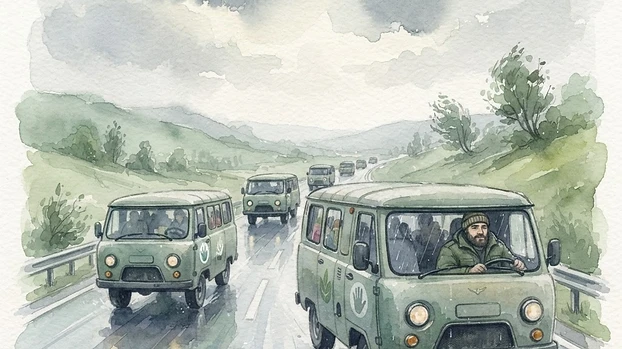
By morning, the storm had moved on from Ohio, leaving the townhouse damp, quiet, and rearranged around Sum-ma’s arrival. Six vehicles left before sunrise, carrying Gruff, Brute, water, generators, tools, tarps, hygiene kits, blankets, cooking equipment, and enough donated food to make Brute suspicious of canned tomatoes as a political movement.
Gruff drove the lead box truck.
Brute sat beside him with his seat reclined and both boots against the dashboard.
Gruff tapped the side of one boot.
Brute ignored him.
Gruff tapped it again.
“I know you hate feet on the dashboard,” Brute said without opening his eyes.
Gruff pointed at the windshield and mimed an explosion with his hands.
“Yes, I understand airbags,” Brute said. “I am emotionally prepared for my kneecaps to become earrings.”
Gruff repeated the explosion, adding sound effects this time.
“It is five thirty in the morning,” Brute said, finally dropping his boots. “You are not allowed to become a public-service announcement before sunrise.”
Gruff reached over and pushed Brute’s boots down himself.
Brute sat upright. “That was intimate.”
Gruff shook his head.
They traveled for nearly an hour without speaking.
Ohio passed behind them in stretches of dark highway, fields, warehouses, truck stops, and sleeping towns. A faint gold light appeared at the edge of the sky.
Brute watched Gruff from the corner of his eye.
At home, Gruff often lived behind gestures. He communicated through raised eyebrows, pointed fingers, tilted heads, grunts, nods, and looks detailed enough to require punctuation.
He spoke when something needed saying.
Then he frequently followed his words with a hug, a wink, or a change of subject, as though sincerity embarrassed him.
But as the miles accumulated and the children remained safely behind them, something inside him began to loosen.
Gruff shifted in his seat.
“Coffee’s gettin’ cold,” he said.
The words came out wrapped in the Southern accent he usually tried to flatten.
Brute turned slowly.
Gruff glanced at him.
“Oh, I’m sorry,” Brute said, turning slowly in his seat. “Were you speaking to me, Colonel Cornbread?”
Gruff tightened his mouth.
“Say something else.”
“No.”
The single word stretched warmly.
Brute grinned. “There he is.”
“Ain’t nobody here,” Gruff said, his eyes fixed on the road, though one corner of his mouth betrayed him.
“I am here.”
“You don’t count.”
“I am your emotional-support asshole,” Brute said, hand over his chest.
“That part’s true,” Gruff said.
Brute leaned back, delighted. “You hide that accent like it owes you money.”
Gruff kept his eyes on the road. “People hear it and decide things.”
“What things?”
“That I’m dumb. Or country. Or that I wrestle livestock.”
“You did wrestle livestock.”
“One goat.”
“The goat won.”
“The goat cheated,” Gruff said, still serious enough to make it worse.
“How?”
Gruff glanced at him. “Had horns.”
Brute laughed hard enough to wipe tears from his eyes.
Gruff tried not to smile.
He failed.
For the next several miles, Brute demanded words he believed would emphasize the accent.
“Say tire.”
“No.”
“Say oil.”
“No.”
“Say mayonnaise.”
“Why in God’s name would I say mayonnaise?”
Brute slapped the dashboard.
“Beautiful. Absolutely beautiful. You put four extra syllables in God.”
Gruff shook his head, but the smile remained.
They crossed another state line.
The highway began to fill with utility trucks, military vehicles, disaster-response vans, and pickups carrying ladders, tarps, and bottled water.
Brute’s humor softened.
“You nervous?”
Gruff looked ahead.
“Folks down there lost everything,” he said. “We’re showin’ up for a week.”
“A week can matter.”
“Not enough.”
“It is never enough for you.”
Gruff’s hands tightened around the steering wheel.
Brute recognized the movement. They had reached the edge of something Gruff did not want opened.
He let the silence stay.