Chapter One: The Morning Splits in Two
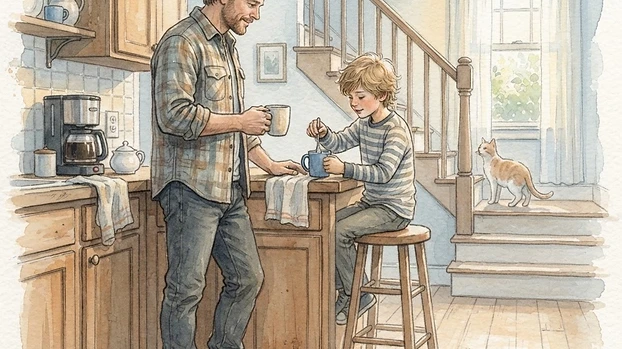
Career Day began before the sun had fully climbed over the rooftops of their Delaware neighborhood, before the traffic thickened on the main road, before school buses sighed to a stop at corners, and before the day had decided what kind of memory it would become.
The morning sky was pale blue and silver, with a thin gold line beginning to glow behind the rooftops. Inside the townhouse, the world was still soft around the edges. The refrigerator hummed. Coffee mugs clinked. A cat padded somewhere upstairs. Brute’s heavy work boots crossed the kitchen floor with the steady confidence of a man who had learned that ordinary mornings could still lead to extraordinary lessons.
Freddy had chosen to follow Brute almost immediately after the school announced the assignment, not because it was the easiest choice, but because something in him leaned toward machines, systems, and the hidden logic that made large things move safely through the world.
There had never been much question about it.
He wanted to see the buses, the garage, the diagnostic equipment, and the enormous engines Brute talked about with the same excitement other people reserved for sports or expensive cars. Freddy had always been interested in computers and engineering, but until that morning those interests still felt like ideas floating somewhere ahead of him. Brute had promised to show him that technology was not trapped inside screens. It lived inside brakes, sensors, wiring, engines, and every system designed to carry people safely from one place to another.
Theresa had chosen Gruff, though her morning would begin differently and, in ways she could not yet imagine, more quietly.
She needed to stop at school first.
A folder containing the official Career Day worksheet was still inside her locker, along with a notebook, two pens, and a book she had promised to return to the school library. Rather than make Gruff wait in the school parking lot, they agreed that Brute would drop her off on the way to Ohio State. Theresa would collect her things, sign out through the office, and then meet Gruff at the Soup Kitchen.
Gruff planned to leave home earlier than everyone else.
He always liked having the first portion of the day alone in the kitchen.
Theresa had heard him say this many times, but she had never thought much about what it meant. Gruff spent time alone at home too. Sometimes Brute worked late. Sometimes Freddy had practice, Theresa stayed after school, and the townhouse became quiet for an hour or two.
She assumed solitude was solitude.
She did not yet understand that Gruff’s time alone at the Soup Kitchen was entirely different from his time alone at home.
At home, even when no one else was present, Gruff remained surrounded by the family’s belongings, responsibilities, and routines. There was always laundry waiting, a dish in the sink, a bill on the counter, a cat asking to be fed, or a reminder of something that needed to be finished. Home was where Gruff rested, worried, planned, cared for everyone, and waited for the people he loved to return. It was warm, safe, and full of love, but it was never empty of responsibility.
The empty Soup Kitchen gave him something else.
It gave him room to play, to breathe, to remember who he was beneath the lists and worries, and to begin the day by turning service into something almost joyful.
Downstairs, Brute stood beside the kitchen island wearing his navy Ohio State work shirt. His name was embroidered above one pocket, and the university fleet-services logo rested above the other. A heavy ring of keys hung from his belt and struck his leg whenever he moved, each small metallic sound seeming to announce that he belonged to a world of vehicles, schedules, responsibility, and motion.
Freddy came down the stairs wearing jeans, work boots, and an OSU sweatshirt that had once belonged to Brute.
It no longer looked oversized.
Brute turned and stared at him.
“Well, would you look at that,” Brute said, leaning back as if Freddy had just rolled off an assembly line. “The boy woke up factory upgraded.”
Freddy stopped on the final step. “What does that even mean?”
“Height package. Shoulder expansion. Possible sarcasm enhancement.”
“I did not grow overnight.”
“That is exactly what a person who grew overnight would say.”
Freddy looked toward Gruff for rescue.
Brute circled him slowly, inspecting him the way he inspected a campus bus before allowing it back into service.
“Frame looks solid. Suspension questionable. Attitude light is definitely on.”
“You saw me yesterday.”
“Yesterday you were smaller and less expensive to feed.”
“I ate one bowl of cereal.”
“One bowl today,” Brute said gravely. “Tomorrow you’ll be eating drywall and asking for protein powder.”
“Enjoy it while you can.”
“You’re the one going bald.”
“I am not going bald. My forehead is becoming more powerful.”
From the doorway, Theresa laughed.
“If Freddy eats drywall, I’m not sharing a bathroom with him,” Theresa said from the doorway.
Brute pointed at both of them. “This is exactly why I requested respectful children and received a comedy troupe.”
“You trained us,” Freddy said.
“I trained you in confidence, not mutiny.”
Theresa lifted one shoulder. “Fine line.”
“A line both of you have driven over without turn signals.”
Gruff entered the kitchen carrying his travel mug and a ring of keys. He wore loose black chef pants and a white kitchen shirt with the sleeves rolled to his elbows. His tattoos traveled down both forearms, disappearing beneath the cuffs.
He glanced at Brute’s thinning hair.
“Leave the boy alone,” Gruff said. “If he takes after you, he’ll be loud, stubborn, and weirdly popular with strangers.”
Brute placed a hand against his chest.
“That sounded like a compliment wearing work boots,” Brute said.
“It was. I married the whole condition.”
“Not emotionally.”
Gruff kissed him briefly.
“You’ll survive.”
Theresa adjusted her backpack.
“Are you sure it’s okay that I meet you there?”
Gruff nodded. “Take your time at school. I’ll already be prepping by the time you arrive. And Theresa?”
She looked up. “Yeah?”
“Remember this,” Gruff said. “A job tells you what someone does. The way they do it tells you who they are.”
He let the words settle before adding, “Look for the why, Theresa. That is where the truth lives.”
Theresa had expected instructions. Gruff had given her a compass.
Theresa frowned slightly. “Is this a Career Day lecture or a life lecture?”
“Yes,” Gruff said.
“That was not an answer.”
“It was the answer you needed,” Gruff said. “Do not just study the work. Study the heart behind it.”
Brute picked up his coffee.
“Knowing Gruff, he’ll still jump three feet in the air when you walk in.”
Gruff looked at him. “I don’t scare that easily.”
All three members of his family stared at him.
Gruff frowned. “I scare an appropriate amount.”
Theresa smiled. “I’ll see you soon.”
Gruff placed one hand gently on the side of her head and kissed her forehead.
“Pay attention at school,” he said, gentle but firm. “Notice who is trying, who is tired, and who still shows up.”
“I’m only picking up my folder.”
“Pay attention anyway. The best lessons are usually hiding behind ordinary things.”
Theresa rolled her eyes, but she tucked the words away anyway. Gruff had a habit of saying ordinary things that became important hours later.
Brute opened the front door.
“Come on, children. The great state of Ohio awaits, and it is not emotionally prepared for us to be late.”
Freddy followed him outside.
Theresa walked behind them, and Gruff remained in the doorway for a moment, watching his family leave.
Brute was already telling Freddy about the different classifications of commercial driver’s licenses before they reached the truck.
Theresa smiled as she climbed into the back seat.
Within ten minutes, she was dropped off near the school entrance.
“Call us if you need anything,” Brute said through the open window.
“I’m going five blocks away.”
“Danger can occur within five blocks,” Brute said. “Danger has no respect for zoning.”
Freddy leaned across the passenger seat. “He gave me a safety lecture before I got in the truck. I was standing in the driveway, fully visible, wearing shoes, and somehow still considered at risk.”
“Driveways are transitional zones,” Brute said. “People get careless in transitional zones.”
“You made that up,” Freddy said.
“I made it sound official, which is half of safety training.”
Theresa adjusted her backpack. “Do you have a pamphlet, or is this a live performance?”
“Both, if you keep encouraging me.”
“As he should,” Theresa said. “He has a gift. A terrifying, repetitive gift.”
Brute pointed at Theresa. “See? Your sister understands responsibility.”
“Responsibility means checking both ways, staying off your phone, trusting your instincts, and never assuming a parking lot is harmless just because it has painted lines and shrubs.”
Freddy whispered, “The shrubs are involved now.”
“Shrubs create blind spots,” Brute said without missing a beat.
Theresa pointed toward the school entrance. “I am walking into a building full of adults.”
“Adults are not a safety feature,” Brute said. “I have met adults.”
Freddy nodded solemnly. “He works with them every day. He has data.”
“She’s agreeing so you’ll leave.”
Brute considered this.
“Still counts,” Brute said. “Emergency preparedness often begins with reluctant compliance.”
Theresa closed the truck door and stepped back.
Freddy waved as they pulled away.
Brute began speaking again before the truck reached the end of the parking lot. Theresa could not hear what he was saying, but she saw Freddy laugh and shake his head.
The fun pair were officially on their way, carrying one notebook, one overstuffed safety lecture, and the first sparks of a day that would teach both children that work was never only work. It was love in motion, responsibility made visible, and sometimes the doorway into understanding the people who had been standing beside them all along.