Chapter 1: The Sideways Biscuit
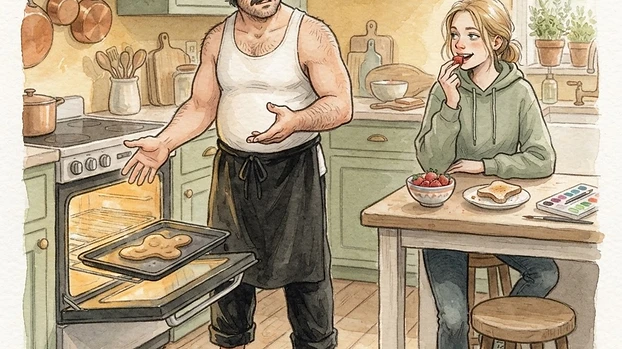
The morning of Theresa’s biggest soccer game began with Gruff arguing with a biscuit.
It was not unusual for Gruff to speak to food. In fact, almost everything in his kitchen received some form of conversation. The refrigerator was praised when it kept a proper temperature, the oven was threatened whenever it heated unevenly, and the heavy mixer had once received a fifteen-minute lecture about “respecting the dough.”
That morning, however, one particular biscuit had offended him personally.
“You had one responsibility,” Gruff muttered, standing barefoot in front of the oven in his loose black chef pants and white undershirt. “One. Rise up proud and respectable. Instead, you spread sideways like a porch cat that gave up on ambition.”
Theresa sat at the kitchen island with one leg folded beneath her, eating a bowl of strawberries and pretending not to listen.
The biscuit remained silent, which Gruff considered suspicious.
Gruff narrowed his blue eyes at it.
“You ain’t gonna say nothin’? Course you ain’t. Coward.”
Theresa finally laughed.
Gruff glanced over his shoulder. “You find somethin’ amusing, Miss A-Game?”
“I think you intimidated it.”
“That biscuit knew the risks when it entered my oven.”
It was just after seven in the morning. Theresa’s game did not begin until one that afternoon, but Gruff had been awake since five. He had already prepared biscuits, scrambled eggs, turkey sausage, fruit, and a pan of roasted breakfast potatoes. He claimed athletes needed a proper meal before competition.
Theresa had pointed out that no soccer coach in the world would recommend eating an enormous country breakfast six hours before a game.
Gruff had responded that no soccer coach in the world had been raised by his mother.
That had ended the debate.
Outside, a gray August sky hung over their townhouse neighborhood in Delaware, Ohio. The air was already warm and heavy, promising either a muggy afternoon or a sudden storm. The trees behind the row of homes stood still, their leaves barely moving.
Inside, the house was not still at all.
Brute was upstairs looking for his wallet.
Freddy was attempting to repair the broken zipper on his favorite Ohio State sweatshirt, even though it was far too hot to wear it.
Gruff was conducting a personal investigation into the structural failure of a biscuit.
And Theresa, already dressed in her warm-up pants and team shirt, was trying to keep her thoughts from racing ahead to the soccer field.
This was not an ordinary game.
Her team had spent the entire summer working toward the regional semifinal. A victory today would send them to the championship match. A loss would end their season.
Theresa did not like thinking about the second possibility.
At sixteen, she had learned how to hide nervousness well. Her teammates saw a quiet midfielder who rarely panicked, rarely argued, and almost always seemed to know where the ball needed to go before it reached her. Her coaches saw discipline. Her teachers saw a 4.0 student with a carefully organized future.
Gruff saw everything else.
He saw the way she had checked her equipment three times before breakfast. He saw her tapping her left foot against the leg of the island. He saw that she had eaten only two strawberries despite normally finishing the bowl before anyone else sat down.
Gruff abandoned the biscuit and walked to the island.
“You worried?”
“No,” Theresa said, too quickly.
He placed both hands on the countertop and leaned toward her, not quite smiling.
“That answer came out faster than a mouse at a cat convention.”
“I’m focused,” she said, which sounded better than nervous and almost meant the same thing.
“That ain’t what I asked, and you know it.”
Theresa looked toward the window.
Gruff waited.
His patience was one of the things that made him difficult to avoid. He did not always speak much, but when he wanted an honest answer, he could stand silently for an uncomfortable amount of time. He did it with his employees at the soup kitchen, with Freddy when his grades slipped, and with Brute whenever Brute claimed he had not eaten the last slice of pie.
Eventually, Theresa sighed.
“A little.”
“A little worried?”
“Focused at a professional level.”
“Mmm-hmm.”
“We’ve worked all season for this.”
“I know.”
“Olivia rolled her ankle yesterday,” Theresa said. “Coach says she can start, but nobody knows how long she’ll last. Madison and Kayla are already arguing about who moves up. Hannah keeps trying to run every drill like it belongs to her. Nobody’s listening.”
Gruff nodded slowly.
“And you’re thinkin’ you gotta fix all of it.”
“I’m one of the captains.”
“You’re one of the captains,” he repeated. “That don’t mean you gotta be the Holy Spirit, too.”
Theresa stared at him.
From the staircase came Brute’s voice.
“Has anybody seen my brown wallet?”
Gruff did not turn around.
“It’s on your dresser!”
“I looked there!”
“Then look again, but this time open your eyes!”
There was a pause.
“Never mind,” Brute called. “My eyes have been activated.”
Theresa smiled despite herself.
Gruff leaned closer. “Now, listen. You remember the first time I let you run the dinner line at the kitchen?”
Theresa groaned. “The spaghetti disaster.”
“The spaghetti educational opportunity.”
“The noodles stuck together.”
“Because somebody forgot to stir ’em.”
“The sauce burned.”
“The sauce was challenged.”
“We ran out of garlic bread.”
“Because somebody let Freddy sample half a tray.”
From the living room, Freddy shouted, “I was twelve!”
“You was hungry!” Gruff called back.
“That doesn’t make it my fault!”
Gruff looked at Theresa again. “Everything went wrong that night.”
“I remember.”
“You also remember what happened next?”
Theresa did.
She had been thirteen at the time and desperate to prove she could manage the serving line on her own. She had made schedules, counted portions, and assigned everyone a station. On paper, her plan had been perfect.
In reality, one volunteer had arrived late. Another had mistaken salt for sugar while preparing the tea. The pasta had clumped, the sauce scorched, and the garlic bread disappeared at a rate no one could explain until Freddy was discovered in the pantry surrounded by crumbs.
Theresa had tried to correct every problem herself.
Within twenty minutes, she had been near tears.
Gruff had stepped beside her, tied on his apron, and quietly asked what the team needed.
Not what she needed to do.
What the team needed.
They separated the pasta into smaller pans. One volunteer thinned the sauce while another started a fresh batch. Gruff turned the ruined bread into seasoned croutons and served them over salad. Freddy was reassigned to filling cups where he could be watched.
Dinner had started twelve minutes late.
No guest complained.
Most returned for seconds.
“You told me a leader doesn’t have to do every job,” Theresa said, quieter now.
Gruff nodded.
“A leader makes sure every job gets done. There’s a difference.”
“I know.”
“Do you?”
“Yes.”
“Then why you sittin’ here actin’ like you gotta personally carry eleven soccer players across the finish line?”
“There isn’t a finish line in soccer.”
“You know what I mean, Smarty-Pants.”
Theresa ate another strawberry.
Gruff slid the plate of eggs closer to her.
“You bring your A-game by helpin’ everybody else find theirs. Same as a kitchen. You got one person tryin’ to do everything, you ain’t got a team. You got a fool surrounded by witnesses.”
Theresa laughed again.
Gruff pointed toward the food. “Eat.”
“I’m not that hungry.”
“Eat.”
“I’ll get sick if I eat too much.”
“I ain’t askin’ you to swallow the whole farm. Eat some eggs.”
Theresa obeyed, taking a small helping.
Gruff returned to the stove, satisfied.
Brute appeared at the bottom of the stairs dressed in jeans and a scarlet Ohio State polo. His thinning hair was freshly combed, and his beard looked suspiciously damp, as though he had attempted to tame it with water.
“You look nice,” Theresa said.
Brute patted his stomach. “Your father said I dress like a man who sells used riding mowers at parent-teacher conferences.”
Gruff glanced over. “I said you look like you’re fixin’ to sell somebody a used riding mower.”
Brute looked down at himself.
“What’s wrong with my shirt?”
“Ain’t nothin’ wrong with it.”
“You just said—”
“I said what you look like. I didn’t say it was bad.”
“What does a person selling a riding mower look like?”
“Like that.”
Freddy entered from the living room with the broken sweatshirt zipper in one hand and a pair of pliers in the other.
“Can somebody help me?”
Gruff’s face tightened.
“Why do you have my kitchen pliers?”
“They were in the drawer.”
“That don’t make ’em yours.”
“I’m fixing my zipper.”
“You’re fixin’ to lose a finger.”
Brute reached for the sweatshirt. “Give it here. I can repair a zipper.”
Gruff stared at him.
Brute noticed.
“What?”
“You spent forty minutes last month trying to repair a can opener.”
“The gears were stripped.”
“You put motor oil on it.”
“It reduced friction.”
“It reduced the can opener to garbage.”
Freddy quietly lowered the pliers.
Theresa checked the time on her phone. Seven twenty-three.
Her coach wanted every player at the athletic complex by eleven thirty. Theresa planned to leave at ten forty-five, giving herself plenty of time even if traffic was heavier than usual.
The rest of the family intended to leave at eleven.
Gruff had announced the schedule the previous night as though preparing a military operation.
Breakfast at seven.
Equipment check at eight.
Theresa’s final stretch and rest period from nine to ten.
Cars loaded by ten thirty.
Theresa departed at ten forty-five.
Everyone else departed at eleven.
No exceptions.
Gruff believed punctuality was a form of respect. He had once arrived forty minutes early to a dentist appointment because Brute warned there might be traffic. When the receptionist told him he could return closer to his scheduled time, Gruff sat in the waiting room and said, “I done made it here. I ain’t temptin’ fate twice.”
Nothing, Gruff insisted, would make them late for Theresa’s game.
The universe apparently heard this, rolled up its sleeves, and called a meeting.